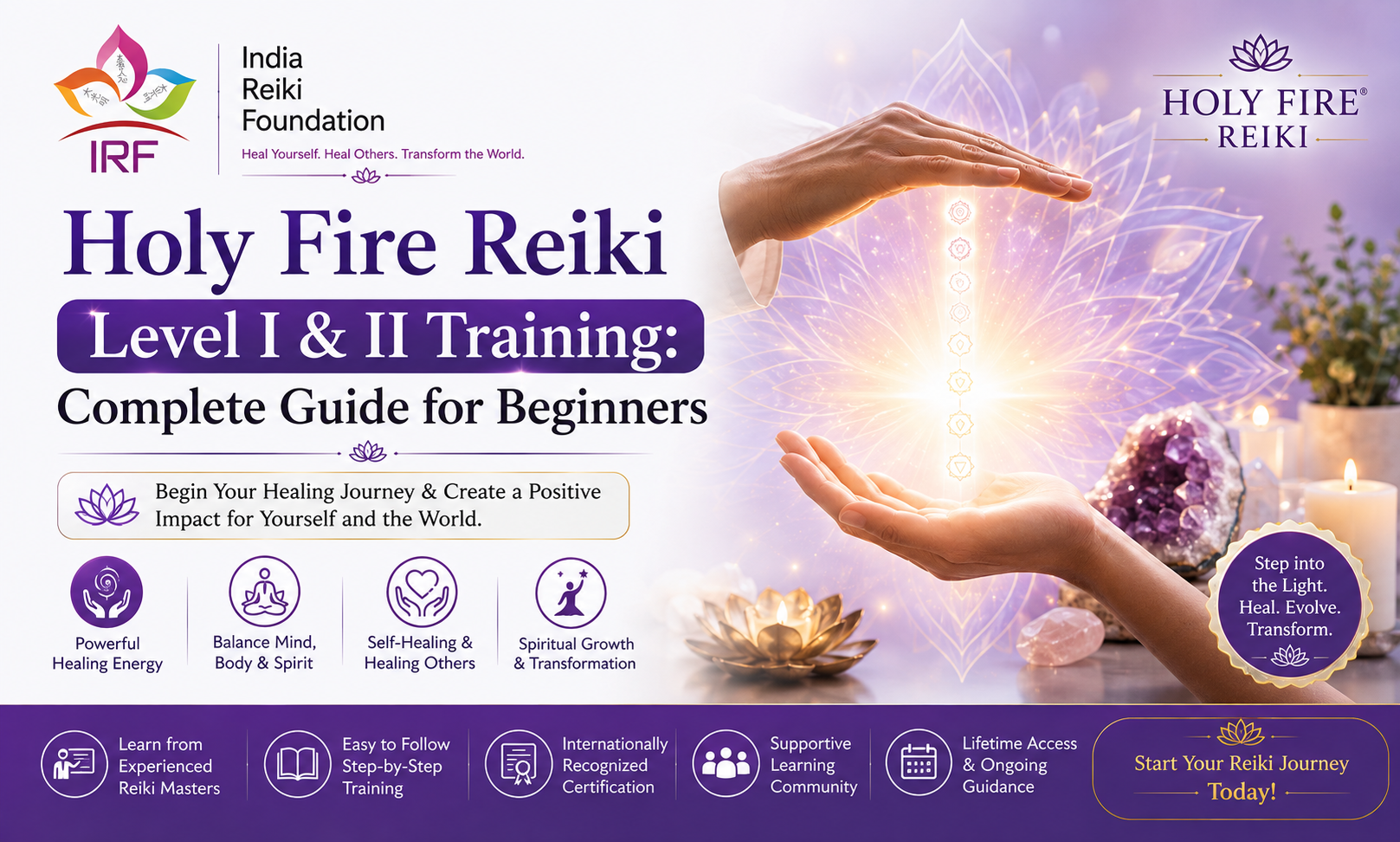
Starting Reiki for the first time often brings a mixture of curiosity and questions. You may want to know what Holy Fire Reiki is, whether previous spiritual or healing experience is necessary, what happens during Level I and Level II, and whether Reiki can be studied effectively through online training. Holy Fire Reiki Level I & II Training is designed to create a progressive foundation for people beginning their Reiki journey. Rather than introducing advanced techniques immediately, the learning process starts with Reiki principles, energy awareness and self-practice before progressing toward Reiki symbols, emotional and mental applications, sessions for others and distance Reiki.
At India Reiki Foundation, Holy Fire Reiki Level I and Level II are taught together as a structured foundational program. Students are introduced to subjects including Reiki energy, aura and chakras, grounding, self-Reiki, traditional hand positions, Holy Fire experiences, Level II symbols, distance Reiki and practical approaches to conducting Reiki sessions. For anyone considering a Holy Fire Reiki Course Online, Online Reiki Course or Reiki Healing Course, understanding what each level contributes can make it easier to choose the right training path.
Reiki is approached as an energy-based and spiritual wellness practice for meditation, personal growth, energy awareness and complementary wellbeing. It should not be used as a substitute for medical diagnosis, professional healthcare or prescribed treatment. This beginner’s guide explains what you can expect from Holy Fire Reiki Level I & II and how these foundational levels can prepare you for continued Reiki practice.
What Is Holy Fire Reiki?
Holy Fire Reiki is a contemporary form of Reiki introduced by William Lee Rand in 2014. It developed within the broader Reiki tradition while introducing its own terminology, experiences and methods of energetic initiation.
Within Holy Fire Reiki practice, the energy is commonly associated with purification, empowerment, spiritual awareness and personal development. Like other Reiki systems, it is based on the concept of universal life-force energy flowing through the practitioner rather than being generated from the practitioner’s personal energy. A Reiki practitioner generally works through intention, meditation, awareness and gentle hand positions while allowing Reiki to flow naturally.
Holy Fire Reiki also incorporates processes known as Placements, while advanced training includes Ignitions. These distinguish its training structure from Reiki systems that rely primarily on conventional teacher-led attunements. Beginners do not need to understand every advanced aspect of Holy Fire Reiki before starting. The initial focus is simply to develop an understanding of Reiki, experience self-practice and gradually become familiar with the energy system.
What Does Holy Fire Reiki Level I & II Training Include?
Holy Fire Reiki Level I & II provides the first major stage of structured Reiki learning. The two levels have different purposes but are closely connected. Level I establishes the student’s personal foundation. It introduces Reiki concepts, self-Reiki, hand positions, grounding, aura awareness, chakras and basic energy practices. Level II develops the practice further by introducing Reiki symbols, emotional and mental applications, Reiki for other people and distance Reiki.
India Reiki Foundation combines these stages into one progressive course so students can understand how personal Reiki practice develops into broader practitioner-level techniques. The program includes theoretical explanations as well as meditation, practical exercises, Holy Fire experiences and opportunities for questions. Reiki is an experiential discipline, so understanding the techniques through practice is just as important as learning their definitions.
Is Holy Fire Reiki Level I & II Suitable for Complete Beginners?
Yes. A person can begin Holy Fire Reiki Level I without previous Reiki or energy-healing experience. The training is structured to introduce concepts gradually, making it suitable for learners who are completely new to Reiki as well as people who have already explored meditation, yoga, spirituality or other complementary wellness practices. Beginners are not expected to know about chakras, aura cleansing, Reiki hand positions or energy techniques before joining.
These subjects form part of the learning process. What matters more is developing patience and a willingness to practise consistently. Level I encourages students to become comfortable with Reiki through self-practice before relying heavily on the more expanded techniques introduced in Level II. For this reason, learning the foundations properly is more valuable than trying to move through different Reiki levels as quickly as possible.
Is Previous Reiki Experience Necessary?
No previous Reiki qualification is required to begin Holy Fire Reiki Level I. India Reiki Foundation explains that there are no specific educational qualifications necessary for starting Reiki training. However, Reiki education follows a progressive structure, meaning learners should begin at an appropriate foundational level before entering advanced stages.
This is an important distinction.You do not need to be a healer before enrolling, but understanding Reiki step by step helps create a stronger foundation for future practice. Level I introduces the fundamentals of energy awareness, grounding, self-Reiki and hand positions. Level II then builds upon those concepts with symbols, distance practice and applications for working with others. People who have previously studied another Reiki system may also explore Holy Fire Reiki to understand its specific techniques and training approach.
Who Can Study Holy Fire Reiki Level I & II?
Holy Fire Reiki Level I & II may be explored by adults from a variety of backgrounds who are interested in Reiki, meditation, spiritual growth or complementary wellness.
The course can be relevant for:
- Complete beginners exploring Reiki for the first time
- People interested in self-Reiki and meditation
- Existing Reiki practitioners
- Yoga practitioners
- Therapists and wellness professionals
- People studying spiritual or energy-based practices
- Learners interested in becoming Reiki practitioners
- Individuals seeking a structured path toward advanced Reiki training
Some students study Reiki mainly for personal development, while others want to incorporate Reiki into an existing wellness practice. There is no requirement to follow a specific religion or possess a particular academic qualification. A willingness to learn and practise consistently is far more relevant.
How Are Holy Fire Reiki Level I and Level II Different?
Although they are often taught together, Reiki Level I and Reiki Level II have separate learning objectives.
Level I concentrates on creating the foundation.
Students learn about Reiki, the human energy system, self-Reiki techniques, chakras, aura awareness, grounding and fundamental hand positions.
Level II builds on this base and introduces additional tools.
Students begin learning Reiki symbols and how they are used within specific practices. They also explore emotional and mental Reiki applications, distance Reiki and approaches for offering Reiki to other people. A simple way to understand the progression is:
Level I develops your personal Reiki practice. Level II broadens how you can apply Reiki.
Both stages are important because advanced applications are easier to understand when the student already has experience with foundational Reiki techniques.
What Will You Learn in Holy Fire Reiki Level I?
Holy Fire Reiki Level I centres largely around understanding Reiki and learning how to practise it personally. At India Reiki Foundation, Level I includes the history and principles of Reiki, basic concepts of energy, awareness of chakras and aura, Reiki hand positions, grounding, protection, energy hygiene, self-healing methods and Holy Fire meditation experiences. Students begin exploring how Reiki practice can be integrated into their daily routine. During self-practice, people may notice different experiences. Some may become aware of warmth, relaxation or sensations in their hands. Others may experience greater calm or simply become more focused during meditation.
There is no single experience that every Reiki student must have. A major objective of Level I is to establish regular self-Reiki. Repeated practice allows students to become more comfortable with Reiki before they begin concentrating on sessions for other people or more advanced techniques. Anyone comparing different Reiki Healing Course options should therefore look for a Level I syllabus that combines theory with guided experience and practical training.
What Will You Learn in Holy Fire Reiki Level II?
Level II expands upon the personal foundation developed during Level I. India Reiki Foundation introduces three important Reiki symbols during this stage: the Power symbol, Harmony symbol and Distance symbol. Students learn the purpose of the symbols, how they are incorporated into Reiki practice and the situations in which they may traditionally be used.
Level II also covers Reiki for others, distance Reiki, emotional and mental applications, energy clearing and practical considerations related to Reiki sessions. This level often represents an important transition because students begin moving from primarily practising Reiki on themselves toward understanding how Reiki sessions can be structured for other people.
Ethical practice, consent, appropriate boundaries and responsible communication also become increasingly important when Reiki is offered to others. Completing the course provides a foundation, but confidence develops through continued practice after training.
Which Reiki Symbols Are Introduced in Level II?
Holy Fire Reiki Level II at India Reiki Foundation introduces three symbols:
Power Symbol
The Power symbol is associated with focusing or strengthening Reiki intention during practice.
Harmony Symbol
The Harmony symbol is traditionally connected with emotional and mental applications of Reiki.
Distance Symbol
The Distance symbol is used within the practice of distance Reiki, where Reiki is offered without the practitioner and recipient being physically together. Learning Reiki symbols involves more than memorising their appearance.
Students need to understand why each symbol is used, how it fits into a Reiki session and the intention associated with its application. For this reason, Level II symbols are best learned as part of structured training rather than through disconnected online information.
What Is a Holy Fire Reiki Placement?
One feature that distinguishes Holy Fire Reiki from some traditional Reiki systems is the use of Placements. A Placement is an experiential energetic process used within Holy Fire Reiki training. Traditional Reiki systems frequently use the term attunement, generally referring to an initiation process performed by a Reiki Master for a student. Holy Fire Reiki uses a different framework involving Placements and, at more advanced levels, Ignitions.
Within the Holy Fire approach taught by India Reiki Foundation, the experience is understood as being guided through Holy Fire energy rather than depending entirely on direct energetic transmission from teacher to student. For beginners, there is no need to overanalyse the experience. Students are encouraged to follow the guidance provided during the course, remain receptive and avoid comparing their experience with those of other participants. Individual responses to meditation and spiritual practices can naturally vary.
What Is Distance Reiki?
Distance Reiki is introduced during Level II. It refers to a Reiki practice in which the practitioner works with the intention of offering Reiki when the recipient is not physically present. Students learn how to prepare for a distance Reiki practice, establish intention, incorporate the Distance symbol and conduct the process in a structured way. India Reiki Foundation includes distance Reiki for people, situations and circumstances within its Level II curriculum.
Consent and personal boundaries remain important even when a session is performed from a distance. A practitioner should not assume that someone automatically wants to receive an energy-based practice. Distance Reiki is also particularly relevant to students taking an Online Reiki Course, because Reiki learning and practice are not necessarily limited by physical location.
How Is Holy Fire Reiki Different From Usui Reiki?
Holy Fire Reiki and traditional Usui Reiki belong to the wider Reiki tradition, but there are differences in terminology, initiation processes and teaching structure. Usui Reiki forms the historical foundation from which many later Reiki systems developed. Holy Fire Reiki represents a more recent development within Reiki and incorporates processes such as Placements and advanced Ignitions. India Reiki Foundation also presents Holy Fire Reiki with an emphasis on purification, spiritual development and experiential learning.
This does not mean beginners need to choose one system by rejecting another. Students comparing an Usui Online Reiki Course and a Holy Fire Reiki Course Online can instead examine how each program approaches Reiki history, meditation, self-practice, symbols, initiation processes and progression through advanced levels. The right Reiki pathway depends largely on the system and teaching approach with which the student feels most comfortable.
Can Holy Fire Reiki Level I & II Be Learned Online?
Yes. India Reiki Foundation currently provides Holy Fire Reiki Level I & II through online as well as offline learning formats. Online sessions can be attended through Zoom, while other options include in-person and retreat-based learning. The program combines explanations, meditation, experiential practices, Reiki techniques, practical exercises and Q&A. This is different from simply downloading information and attempting to learn Reiki independently.
Live guided training allows students to ask questions, understand techniques in context and follow a structured sequence. An online Reiki format may be particularly convenient for learners who live far from a suitable Reiki centre or prefer studying from home. Before selecting any Holy Fire Reiki Course Online, students should examine whether the program provides clear instruction, practical learning, suitable study material and guidance beyond basic theoretical explanations.
How Long Is Holy Fire Reiki Level I & II Training?
India Reiki Foundation currently conducts its combined Holy Fire Reiki Level I & II program over approximately two days. Training is generally structured around four to five hours per day. The first day focuses primarily on Level I concepts and foundational self-practice. The second day moves into Level II, including Reiki symbols, working with other people and distance Reiki.
However, completing a two-day training program should not be confused with mastering Reiki within two days. The course provides the learning framework. Experience develops later through self-practice, meditation, revision and responsible use of the techniques learned during training. When comparing Reiki courses, therefore, students should consider both course duration and the resources available for continued learning.
Do Students Receive Reiki Certification?
Yes. According to India Reiki Foundation’s course information, learners who complete the combined training receive certification for Holy Fire Reiki Level I & II Practitioner. The program also includes learning resources such as a Reiki manual and guided meditation material. Certification demonstrates that a learner has completed the specified Reiki training program. It does not represent a government-issued medical qualification or healthcare licence.
Students who intend to practise Reiki professionally should continue developing experience, communication skills, ethical awareness and a clear understanding of Reiki’s role as a complementary wellness practice.
Can You Practise Reiki for Others After Level II?
Level II introduces many of the foundational techniques used when practising Reiki with other people. India Reiki Foundation includes Reiki sessions for others, Level II symbols, distance Reiki and practical session guidance within its curriculum. The course therefore establishes practitioner-level foundations.
However, completing the course should be considered the beginning of practical development rather than the end. Students benefit from continuing self-Reiki, revising techniques, developing confidence gradually and practising with proper consent. Responsible Reiki practitioners should also communicate appropriately about Reiki and avoid presenting it as a replacement for medical care.
What Should You Do After Completing Level I & II?
Continued practice is one of the most important steps after finishing Reiki training. Students can continue developing their Reiki experience by practising self-Reiki regularly, revising the three Level II symbols, maintaining meditation practices and gradually working with consenting friends or family members.
Distance Reiki can also be practised according to the methods learned during Level II. For students interested in practitioner work, repeated practice can help build greater familiarity with structured Reiki sessions.
Those who want to progress further may later consider advanced Holy Fire Reiki training. India Reiki Foundation provides Holy Fire Reiki Level III and Masters Training as the next advanced stage within its Holy Fire Reiki learning pathway. There is no need to rush toward Master-level study. Building confidence with the foundational levels first can make advanced learning more meaningful.
How Should Beginners Choose a Holy Fire Reiki Course?
Choosing a Reiki course should involve more than looking at certification alone. A well-designed beginner program should provide a logical progression from foundational understanding to practical application. When evaluating a Holy Fire Reiki Course Online, look for training that includes:
- Clear Level I and Level II learning progression
- Guidance from an instructor
- Self-Reiki practice
- Reiki hand positions
- Chakra and aura awareness
- Grounding and energy hygiene
- Holy Fire experiential processes
- Level II symbols taught with proper context
- Distance Reiki techniques
- Reiki practice for others
- Study resources
- Opportunities to ask questions
- Guidance about responsible practice
- A defined path toward advanced Reiki learning
The objective should be to understand and experience Reiki rather than simply memorising techniques to obtain a certificate.
Why Consider India Reiki Foundation for Holy Fire Reiki Level I & II?
India Reiki Foundation provides structured education in Reiki and related spiritual practices, with training designed to help students understand Reiki concepts through progressive learning and guided experience. Its Holy Fire Reiki Level I & II program combines foundational Reiki knowledge with practical techniques and Holy Fire-specific experiences. The current training covers Reiki principles, aura and chakras, self-Reiki, grounding, hand positions, Holy Fire practices, Reiki symbols, distance Reiki and techniques for working with others.
Key features of the current course include:
- Combined Holy Fire Reiki Level I & II training
- Approximately two days of structured learning
- Around four to five hours of training per day
- Online Zoom learning
- Offline and retreat-based learning options
- Guided meditation and Reiki practices
- Holy Fire experiences
- Reiki Level II symbols
- Distance Reiki training
- Practical sessions and Q&A
- Reiki manual and learning material
- Practitioner-level certification after completion
For someone exploring a Holy Fire Reiki Course Online, Online Reiki Course or structured Reiki Healing Course, the program creates a pathway that begins with beginner-level fundamentals before progressing toward more advanced Holy Fire Reiki study.
Frequently Asked Questions About Holy Fire Reiki Level I & II
Is Holy Fire Reiki suitable if I have never learned Reiki before?
Yes. Holy Fire Reiki Level I begins with foundational concepts, making the combined Level I & II program suitable for complete beginners.
Can I study Holy Fire Reiki online?
Yes. India Reiki Foundation currently offers Holy Fire Reiki Level I & II through Zoom, along with offline learning options.
What is taught in Reiki Level I?
Level I covers subjects such as Reiki principles, self-Reiki, hand positions, chakras, aura awareness, grounding, energy hygiene and Holy Fire experiences.
What is taught in Reiki Level II?
Level II introduces Reiki symbols, Reiki for other people, emotional and mental applications, distance Reiki and related practical techniques.
How many Reiki symbols are included in Level II?
India Reiki Foundation teaches three symbols at Level II: the Power, Harmony and Distance symbols.
What is the main difference between Reiki Level I and Level II?
Level I focuses primarily on personal practice and Reiki fundamentals, while Level II expands the practice through symbols, distance Reiki and applications for others.
What is a Holy Fire Reiki Placement?
A Placement is an experiential energetic process used within Holy Fire Reiki training. It differs from the traditional attunement process used within many other Reiki systems.
How long does the combined training take?
India Reiki Foundation currently structures Holy Fire Reiki Level I & II as approximately two days of training, with around four to five hours of learning each day.
Will I receive certification?
Yes. Students completing the program receive Holy Fire Reiki Level I & II Practitioner certification according to the current India Reiki Foundation course structure.
What comes after Holy Fire Reiki Level II?
After developing sufficient confidence and practice at Levels I and II, students who want to continue can explore Holy Fire Reiki Level III and Masters Training.
Conclusion
Holy Fire Reiki Level I & II Training provides a structured starting point for anyone interested in learning Reiki for personal practice, spiritual development or future practitioner-level applications. Level I establishes the essentials through Reiki principles, energy awareness, chakras, aura understanding, grounding, self-Reiki and hand positions. Level II extends that knowledge through the Power, Harmony and Distance symbols, emotional and mental Reiki applications, techniques for practising with others and distance Reiki.
The real purpose of foundational Reiki education is not to move through levels quickly. It is to understand each stage, practise consistently and gradually develop a meaningful relationship with Reiki. India Reiki Foundation currently offers its combined Level I & II program through a two-day learning format with online Zoom, offline and retreat-based options. Training includes guided practice, Holy Fire experiences, Reiki techniques, Level II symbols, distance Reiki, learning resources and practitioner certification.
For learners searching for an Online Reiki Course or Holy Fire Reiki Course Online, Level I & II can provide a systematic beginning before moving toward advanced training. Completing the course is only the first stage. Continued self-practice, responsible application, respect for consent and boundaries, and ongoing learning help students deepen their understanding over time. Once the foundational techniques become familiar, learners who feel ready can continue toward Holy Fire Reiki Level III and Master-level training.
India Reiki Foundation | Online Reiki Course & Spiritual Healing Academy
Address- 502–503, Stanford Plaza, Veera Desai Road, Andheri West, Mumbai, Maharashtra 400065, India
Phone number +91 96254 88550
Website- https://indiareikifoundation.com/
Mail- mail@indiareikifoundation.com