Beginning Reiki is often accompanied by many questions. Which Reiki system should you learn? Is Level I enough for self-practice? What changes in Level II? Can Reiki genuinely be learned through an online class? And if you eventually want to offer Reiki sessions to others, where should your learning journey begin?
For anyone exploring a Holy Fire Reiki Course Online, choosing structured training is important because Reiki is not only about understanding concepts intellectually. Students also need to learn the foundations of energy awareness, self-practice, Reiki hand positions, meditation, symbols, distance Reiki and the appropriate way to approach a Reiki session. A well-structured Reiki Healing Course can help beginners understand these practices progressively instead of learning disconnected techniques from different sources.
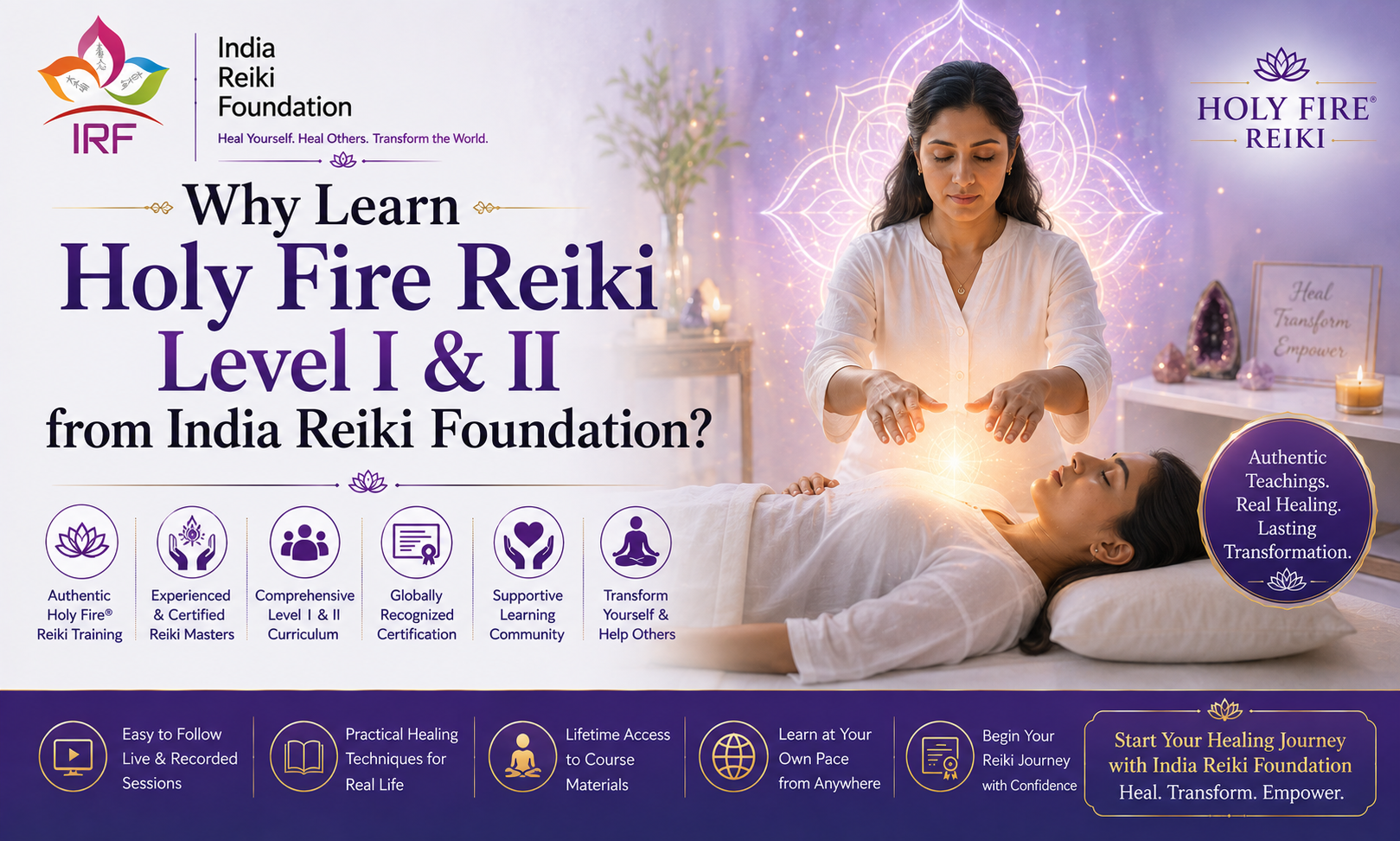
India Reiki Foundation offers Holy Fire Reiki Level I & II as a combined learning path for people who want to begin with the fundamentals and gradually develop a broader understanding of Reiki practice. The training covers self-Reiki, aura and chakra awareness, Reiki techniques, Level II symbols, distant Reiki and practical application. For learners comparing an Online Reiki Course with in-person Reiki training, this structured progression can make it easier to understand what each level is intended to teach.
This guide explains Holy Fire Reiki Level I & II, who can learn it, what is covered in each stage, how online training works, what certification means, and why India Reiki Foundation can be considered when beginning this Reiki learning journey.
Important note: Reiki is generally practised as a complementary spiritual or wellness practice. It should not replace medical diagnosis, treatment or professional healthcare.
What Is Holy Fire Reiki Level I & II and How Does It Work?
Holy Fire Reiki is a modern Reiki system introduced through the work of William Lee Rand and the International Center for Reiki Training. It builds on Reiki principles while incorporating specific Holy Fire experiences and methods of receiving Reiki energy. Holy Fire® is a registered service mark of William Lee Rand.
Holy Fire Reiki Level I & II represents the first major stage of learning for students beginning this system. Rather than treating Reiki as a collection of isolated techniques, the two levels create a progression.
Holy Fire Reiki Level I Builds the Foundation
Level I primarily introduces the learner to Reiki itself. Students begin understanding concepts such as universal life-force energy, energy awareness, the aura, chakras, Reiki hand positions, grounding and self-practice. The focus is largely on becoming familiar with Reiki through personal experience.
A beginner may learn how to:
- Understand the basic principles and background of Reiki
- Become more aware of energy and the human energy field
- Understand the relationship between aura and chakras
- Practise Reiki hand positions
- Give Reiki to oneself
- Practise grounding and energy-clearing techniques
- Develop regular self-Reiki practice
- Become more comfortable with meditation and focused awareness
This foundation is useful because students first learn to work with Reiki personally before moving toward broader applications.
Holy Fire Reiki Level II Expands the Practice
Level II builds on that foundation. At this stage, students are introduced to Reiki symbols and learn how these symbols are traditionally incorporated into Reiki practice. They also explore approaches associated with emotional and mental well-being, distant Reiki and offering Reiki sessions to others.
The current India Reiki Foundation curriculum introduces three Level II symbols described as Power, Harmony and Distance symbols and includes practice in distant Reiki and professional-session guidelines. The combination of Level I and Level II therefore creates a progression of:
Understanding Reiki → Self-Practice → Energy Awareness → Symbols → Reiki for Others → Distance Reiki → Practitioner Development
This is one reason beginners searching for a Holy Fire Reiki Course Online often find a combined Level I & II format helpful.
Who Can Learn Holy Fire Reiki Level I & II?
Holy Fire Reiki Level I & II is generally suitable for beginners as well as people who already have an interest in meditation, spirituality, holistic wellness or other energy practices. You do not necessarily need to consider yourself spiritual or intuitive before beginning Reiki. The first level exists specifically to introduce the foundations.
According to India Reiki Foundation’s current course information, the Level I & II training is open to beginners without previous energy-work experience as well as existing Reiki practitioners and people working in related wellness fields.
Beginners Exploring Reiki
If you have heard about Reiki but have never studied it formally, Level I gives you a structured entry point. Instead of immediately learning advanced symbols and techniques, you begin with the fundamentals of energy awareness and self-practice.
People Interested in Personal Reiki Practice
Not everyone who learns Reiki wants to become a professional practitioner. Some learners explore Reiki because they want to develop a personal meditation, self-awareness or spiritual practice. Level I can be particularly relevant for this purpose because much of the learning focuses on practising Reiki for oneself.
Yoga, Meditation and Wellness Practitioners
People already working with meditation, yoga or complementary wellness practices may also explore Reiki to broaden their understanding of energy-based spiritual practices.
However, Reiki training should always be used within the learner’s appropriate professional scope and should not be presented as a substitute for medical or psychological treatment.
Existing Reiki Students
Someone who has studied another Reiki lineage may also be interested in learning the Holy Fire system to understand its specific practices and teaching approach.
Therefore, a Reiki Healing Course at Level I & II can serve both complete beginners and people looking to expand an existing spiritual practice.
Do You Need Previous Reiki Experience to Join the Course?
No previous Reiki experience is required to begin Holy Fire Reiki Level I & II at India Reiki Foundation. That is an important distinction for people who assume they must already understand chakras, meditation or energy healing before joining.
Level I is designed to create that foundation. India Reiki Foundation’s current course information specifically states that beginners can learn the program and that no particular educational background or prior energy-work experience is required.
What Should a Beginner Know Before Joining?
Although previous Reiki knowledge is unnecessary, approaching the training with realistic expectations can improve the learning experience. A beginner should understand that Reiki is a practice that develops through learning and regular application. Completing a class gives you the framework, techniques and instruction, but confidence develops through continued practice.
It is also helpful to enter the course with:
- A willingness to learn
- Patience with the learning process
- Openness to meditation and guided experiences
- Time for regular self-practice
- Interest in understanding Reiki ethics and boundaries
- Realistic expectations about complementary wellness practices
You also do not need to experience dramatic sensations to practise Reiki. Students may describe their experiences differently, and learning should not become a competition over who feels energy more strongly.
A beginner-friendly Online Reiki Course should therefore focus on understanding, practice and consistency rather than promising specific sensations or outcomes.
What Will You Learn in Holy Fire Reiki Level I & II Training?
A major consideration when choosing any course is its curriculum. The Holy Fire Reiki Level I & II curriculum presented by India Reiki Foundation combines theoretical understanding, meditative experiences and practical Reiki techniques. The current course page includes energy and chakra concepts, self-Reiki, Reiki hand positions, symbols, distance Reiki, aura and space cleansing, and practical guidelines for sessions.
Understanding Reiki Energy
Students first explore what Reiki means within the Reiki tradition and how practitioners understand universal life-force energy. This provides context before techniques are introduced.
Aura and Chakra Awareness
Energy-healing traditions often describe the human energy system through concepts such as the aura and chakras. The training introduces these concepts so students can understand how they relate to Reiki practice.
Self-Reiki Techniques
Self-practice is one of the most important foundations of Level I. Students learn Reiki hand positions and ways of incorporating Reiki into their personal routine.
Developing a consistent self-practice can also help students become more familiar with the sequence and structure of Reiki before practising with others.
Reiki Hand Positions
Students learn standard hand positions for Reiki sessions.
Understanding these positions creates a practical structure that beginners can follow rather than feeling unsure about where to begin.
Japanese Reiki Techniques
The broader IRF Holy Fire Reiki curriculum also lists Japanese Reiki techniques such as Gassho meditation, Reiji-ho, Byosen Scanning, Gyoshi-ho and Kenyoku.
These techniques introduce students to different aspects of focus, awareness and energy practice within Reiki traditions.
Reiki Level II Symbols
Level II introduces three core symbols commonly associated with Reiki II practice. Rather than simply memorising how a symbol looks, students need to understand its intended role and how it fits into Reiki practice.
IRF describes these as:
- Power symbol
- Harmony symbol
- Distance symbol
Understanding when and how a symbol is used is more valuable than memorising symbols without context.
Distance Reiki
Distance Reiki is one of the topics that frequently attracts learners to Level II. Within Reiki traditions, practitioners use specific Level II methods and intention to practise Reiki without requiring the recipient to be physically present in the same location. The IRF curriculum includes distant Reiki as part of its Level II training.
Reiki for Others
Level II begins moving the learner from primarily self-focused practice toward offering Reiki to other people. Students can learn how a session is structured and how Reiki techniques are approached responsibly. This makes the Reiki Healing Course useful for people considering practitioner-level development later.
What Is the Difference Between Holy Fire Reiki Level I and Level II?
The simplest difference is that Level I focuses primarily on Reiki foundations and self-practice, while Level II expands the practice through symbols, distance Reiki and working with others.
Both are connected stages rather than competing courses.
Level I: Learn and Experience the Foundation
Level I commonly focuses on:
- Reiki principles
- Understanding energy
- Aura awareness
- Chakra concepts
- Self-Reiki
- Reiki hand positions
- Grounding
- Energy hygiene
- Meditation
- Beginning Reiki practice
The goal is to build familiarity.
Level II: Expand Your Reiki Practice
Level II commonly introduces:
- Reiki II symbols
- Using symbols within Reiki practice
- Reiki for others
- Distance Reiki
- Emotional and mental applications within Reiki tradition
- Broader energy-clearing applications
- Practitioner-oriented session guidance
A learner can think of the progression as:
Level I: “How do I understand and practise Reiki?”
Level II: “How can I expand the ways I use Reiki?”
This distinction is particularly valuable for people evaluating a Holy Fire Reiki Course Online, because course titles alone do not always make the progression clear.
How Is Holy Fire Reiki Different from Usui Reiki?
Holy Fire Reiki and Usui Reiki should not be viewed as completely unrelated systems. Holy Fire Reiki developed within the broader modern Reiki tradition and is commonly taught alongside Usui Reiki foundations. The International Center for Reiki Training describes Holy Fire Reiki as being incorporated into its Usui Reiki classes.
The main differences are found in how particular lineages structure the training and describe the energetic initiation process.
Traditional Reiki Attunements and Holy Fire Placements
Many traditional Usui Reiki systems use teacher-led attunement ceremonies.
Holy Fire teaching introduced processes commonly called Placements and, at advanced stages, Ignitions. Terminology and teaching structure can vary depending on lineage and course level.
India Reiki Foundation’s material describes its Holy Fire training through guided Holy Fire experiences and energetic initiation processes rather than relying only on the conventional teacher-led attunement model.
Both Share Reiki Foundations
Regardless of these differences, both systems may include familiar Reiki foundations such as:
- Universal life-force energy
- Reiki principles
- Hand positions
- Self-practice
- Meditation
- Symbols at Level II
- Distance Reiki
- Practitioner development
For a beginner, the more useful question therefore may not be “Which Reiki is better?” but rather:
Which training method, teacher and learning structure will help me build a clear and responsible Reiki practice?
This approach makes the comparison more meaningful than simply describing one system as universally stronger than another.
Can Holy Fire Reiki Level I & II Be Learned Online?
Yes. Holy Fire Reiki Level I & II is now taught in live online formats by Reiki teachers internationally, and India Reiki Foundation currently offers its Level I & II course through Zoom as well as offline formats.
Online Reiki learning is therefore no longer limited to watching pre-recorded videos.
What Makes Live Online Reiki Training Different?
A structured live Online Reiki Course can include:
- Real-time instruction
- Guided meditation
- Teacher demonstrations
- Reiki practice
- Questions and answers
- Discussion of symbols
- Distance Reiki practice
- Guided Holy Fire experiences
- Course material
- Follow-along exercises
The ability to communicate with a teacher matters because beginners naturally develop questions once they begin practising.
How Long Is the IRF Level I & II Training?
India Reiki Foundation currently describes its combined Holy Fire Reiki Level I & II program as a two-day format, with approximately four to five hours of training per day. Its page lists Zoom and in-person/retreat options and states that study material and guided audio meditations are included.
Can Online Reiki Learning Be Effective?
The quality of online learning depends less on the word “online” and more on how the course is delivered.
Students comparing a Holy Fire Reiki Course Online should look for:
- Clear curriculum
- Live interaction where possible
- Structured progression
- Practical demonstration
- Opportunities to ask questions
- Guided practice
- Study material
- Clear explanation of Reiki ethics
- Certification requirements
- Information about what to practise after the course
A structured program can therefore make online Reiki education accessible to people who cannot easily travel for training.
Do You Receive Certification After Holy Fire Reiki Level I & II?
Yes. India Reiki Foundation’s current course information states that students completing the training receive certification as a Holy Fire Reiki Level I & II Practitioner. The program also lists a Reiki manual and guided meditation material as part of the course format. However, students should understand what certification represents.
What Does Reiki Certification Mean?
A course certificate generally confirms that you have completed the specified training offered by the training provider. It should not be confused with a medical qualification, government healthcare licence or clinical credential.
Reiki is generally considered a complementary practice, so practitioners should accurately represent their education and avoid making unsupported claims about diagnosing, preventing or curing medical conditions.
Why Is Structured Certification Useful?
Certification can still be valuable because it gives learners a documented learning path. Rather than studying random techniques from multiple sources, a student can demonstrate progression through:
Level I → Level II → Advanced Reiki Study → Master-Level Training
For anyone comparing a Reiki Healing Course, it is therefore useful to check not only whether a certificate is provided but also what was actually taught before that certificate was issued.
The quality of the curriculum matters more than the certificate alone.
Can You Practice Reiki Professionally After Completing Level I & II?
Level II is commonly considered the stage at which students begin developing the skills needed to offer Reiki sessions to others, subject to applicable local rules, appropriate training and responsible professional boundaries.
India Reiki Foundation’s Level II curriculum includes Reiki for others, distance Reiki and practical guidance related to professional Reiki sessions. The course page also describes completion at Level I & II as practitioner-level certification.
What Should You Practise Before Working Professionally?
Receiving a certificate should be viewed as the beginning of practice rather than the end of learning.
Before considering professional Reiki sessions, students should develop consistency in:
- Self-Reiki
- Reiki hand positions
- Full session structure
- Level II symbols
- Distance Reiki
- Grounding
- Energy hygiene
- Communication
- Consent
- Client boundaries
- Record keeping where appropriate
- Knowing when to recommend professional medical support
Practice builds confidence.
Is Reiki Master Training Required Immediately?
No. Students do not need to rush from Level II directly into Reiki Master training.
Regular practice after Level I & II can help learners understand how Reiki fits into their personal or professional path before moving into advanced study. Master-level training becomes relevant when a learner wants deeper Reiki study or eventually wants to explore teaching and advanced practitioner development.
A good Online Reiki Course should therefore encourage progressive learning rather than treating certification as a shortcut to mastery.
Why Choose India Reiki Foundation for Holy Fire Reiki Level I & II Training?
Choosing a Reiki course involves more than comparing fees or deciding between online and offline learning. Students should evaluate the curriculum, progression, practical components and whether the program answers the questions they are likely to face after training.
India Reiki Foundation positions itself as a platform offering Reiki and other spiritual or metaphysical learning programs, and its Holy Fire Level I & II curriculum follows a structured path from beginner foundations to Level II practitioner techniques.
Structured Level I & II Learning
One advantage of studying both levels in a connected program is continuity.
Students begin with self-practice and then progress into symbols, Reiki for others and distance Reiki without treating each concept as an unrelated technique.
Combination of Theory and Practice
The curriculum goes beyond defining Reiki.
It includes:
- Reiki principles
- Energy awareness
- Aura and chakras
- Self-Reiki
- Reiki hand positions
- Grounding
- Meditation
- Level II symbols
- Distance Reiki
- Energy-clearing concepts
- Reiki practice for others
This provides a broader foundation for continuing Reiki study.
Online and Offline Learning Options
For learners unable to travel, IRF currently provides an online Zoom option alongside in-person formats.
This makes the Holy Fire Reiki Course Online accessible to learners who prefer to study from home while still following a structured program.
Learning Material and Guided Practice
Study material is useful because Reiki terminology can feel unfamiliar during the first class.
Having material to revisit after training can help learners remember the sequence of practices, terminology and techniques.
A Path Beyond Level II
India Reiki Foundation also offers Holy Fire Reiki Level III and Masters training, giving students who want advanced study a possible progression beyond the introductory practitioner levels.
This creates a clearer learning pathway rather than ending the Reiki journey after one course.
Suitable for Different Learning Goals
Students may join for different reasons.
One person may want only personal Reiki practice. Another may be interested in meditation and spiritual development. Someone else may eventually want to offer Reiki sessions or move toward advanced Reiki study.
The Level I & II structure provides foundations that can support these different goals without requiring beginners to start with advanced material.
For learners comparing a Reiki Healing Course, that progression is one of the most important factors to consider.
Frequently Asked Questions About Holy Fire Reiki Level I & II
1. Is Holy Fire Reiki Level I & II suitable for complete beginners?
Yes. Holy Fire Reiki Level I begins with foundational concepts such as Reiki principles, energy awareness, aura, chakras, self-Reiki and hand positions. Previous Reiki experience is not required for the India Reiki Foundation Level I & II program.
2. What is taught first in Holy Fire Reiki Level I?
Level I focuses primarily on Reiki fundamentals and self-practice. Students learn about Reiki energy, the aura, chakras, grounding, energy hygiene, Reiki hand positions, meditation and ways to practise Reiki for themselves.
3. What do you learn in Holy Fire Reiki Level II?
Level II expands the practice through Reiki symbols, Reiki for others, distance Reiki and broader emotional, mental and energetic applications within Reiki tradition.
4. How many symbols are taught in Holy Fire Reiki Level II?
India Reiki Foundation’s current Level II curriculum introduces three Reiki symbols described as the Power, Harmony and Distance symbols. Students learn their purposes and how they are incorporated into Reiki practice.
5. Can Holy Fire Reiki be learned online from home?
Yes. India Reiki Foundation currently offers Holy Fire Reiki Level I & II through live Zoom training as well as offline formats, making the course accessible to learners who cannot attend in person.
6. How long does the Holy Fire Reiki Level I & II course take?
IRF currently describes the combined Level I & II program as a two-day training, with approximately four to five hours of learning, meditation, practice and Q&A each day. Course schedules can change, so learners should confirm the latest batch details before enrolling.
7. Can I send Reiki at a distance after completing Level II?
Distance Reiki is included in Level II training. Students learn the Distance symbol and methods traditionally used in Reiki practice when the recipient is not physically present.
8. Will I receive a certificate after the course?
India Reiki Foundation currently states that students completing the program receive a certificate as a Holy Fire Reiki Level I & II Practitioner, along with course study material.
9. Can I become a Reiki practitioner after Level II?
Level II introduces practitioner-oriented skills such as giving Reiki to others, distance Reiki and session guidelines. Students considering professional practice should also gain sufficient practical experience, follow ethical boundaries and comply with any applicable local requirements.
10. What should I look for before choosing a Holy Fire Reiki Course Online?
Look for a structured curriculum, qualified instruction, beginner-friendly teaching, guided practice, Reiki symbols, distance Reiki instruction, opportunities to ask questions, study material, certification details and a clear pathway for continued learning. Avoid choosing an Online Reiki Course solely because it promises quick certification.
Conclusion
Learning Reiki becomes easier when each stage builds naturally on the one before it. Holy Fire Reiki Level I & II creates that progression by beginning with Reiki fundamentals, personal practice and energy awareness before moving toward Reiki symbols, Reiki for others and distance Reiki. For complete beginners, Level I creates the foundation. Students explore Reiki principles, aura and chakra concepts, self-Reiki, hand positions, grounding and meditation. Level II then expands the practice through symbols, distant Reiki and practitioner-oriented techniques. Together, the two levels provide a more complete introduction than trying to collect techniques separately from unrelated sources.
India Reiki Foundation’s current program combines Level I and Level II into structured training with guided practices, course material, online and offline learning options and practitioner certification. For people researching a Holy Fire Reiki Course Online, this allows them to begin their Reiki learning without necessarily travelling for training while still following a progressive curriculum. The right Reiki Healing Course should do more than provide information or a certificate. It should help you understand what you are practising, why different techniques are introduced at different stages, how to develop a consistent self-practice and how to approach Reiki for others responsibly.
Similarly, when selecting an Online Reiki Course, focus on the quality and structure of learning rather than choosing only on convenience. Reiki develops through continued study and practice, and Level I & II should be viewed as the beginning of that journey rather than its final destination. For learners who want to explore Reiki for self-practice, spiritual development or future practitioner training, Holy Fire Reiki Level I & II with India Reiki Foundation offers a structured starting point from which deeper Reiki learning can develop.
India Reiki Foundation | Online Reiki Course & Spiritual Healing Academy
Address- 502–503, Stanford Plaza, Veera Desai Road, Andheri West, Mumbai, Maharashtra 400065, India
Phone number +91 96254 88550
Website- https://indiareikifoundation.com/
Mail- mail@indiareikifoundation.com