Beginning Reiki can feel exciting, but it can also bring many questions. What exactly is Holy Fire Reiki? Can someone with no healing experience learn it? What is taught in Level I and Level II? Are symbols introduced? Can Reiki really be learned online? And what can a student do after completing the foundational levels? For beginners, having clear answers before enrolling is important because Reiki training is not simply about collecting techniques; it involves understanding the system, building a regular personal practice and learning how each level develops progressively.
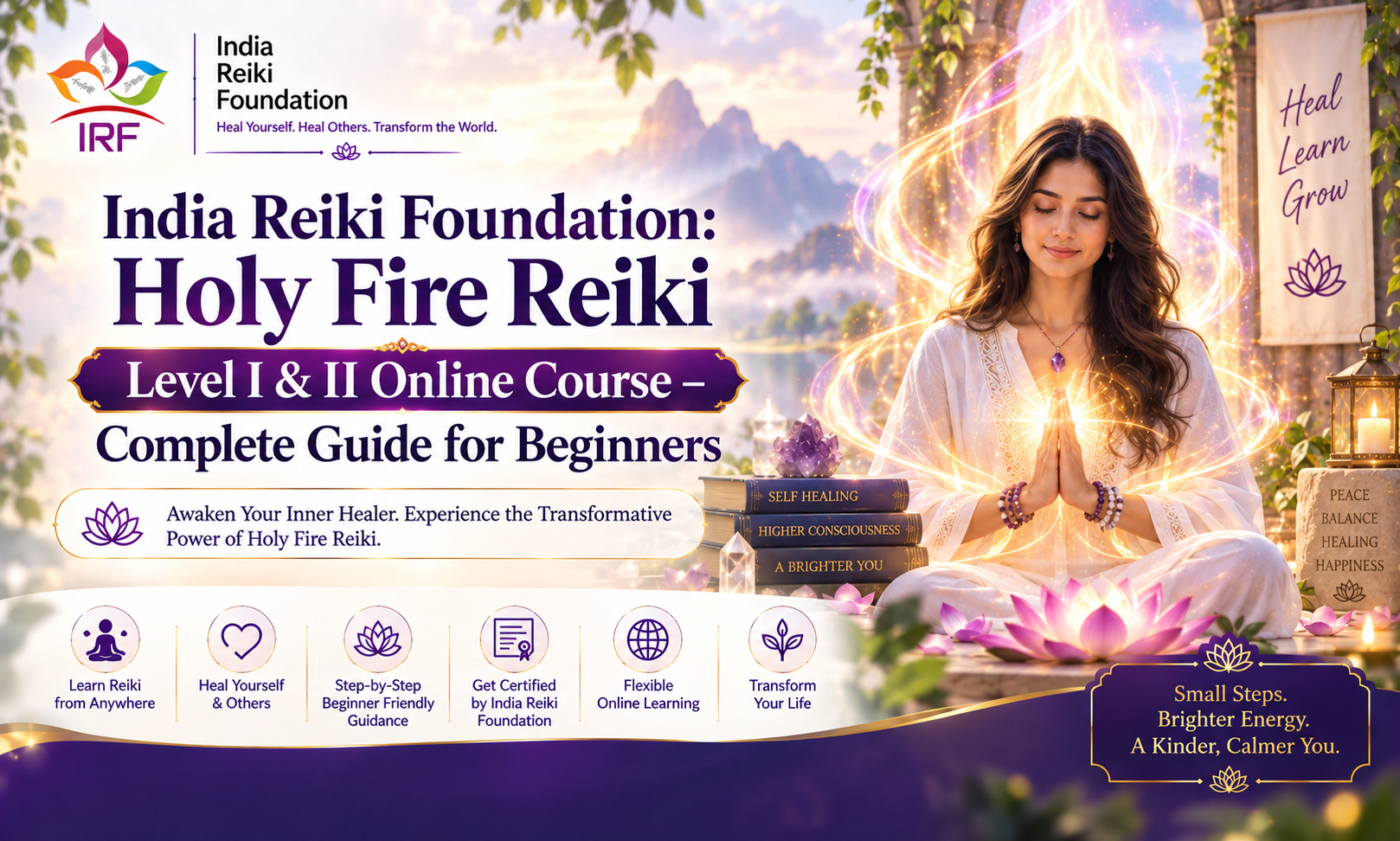
A Holy Fire Reiki Course Online provides a structured way to explore Reiki from home while learning under the guidance of a trained teacher. Holy Fire Reiki is a contemporary Reiki system introduced by William Lee Rand and developed within the broader Usui Reiki tradition. Current Holy Fire Reiki I & II teaching incorporates foundational Reiki principles, self-practice, hand positions, Japanese Reiki techniques, Reiki II symbols, distance Reiki and experiential processes called Placements.
India Reiki Foundation offers Holy Fire Reiki Level I & II as a combined foundational program for beginners and people who want to develop their understanding of energy-based spiritual practice. Its current program is available through live online learning as well as other learning formats and includes guided teaching, practical exercises, meditation, Reiki symbols, distance Reiki and study material. This guide explains the complete learning path so that anyone considering an Online Reiki Course or Reiki Healing Course can understand what to expect before starting.
Reiki is best understood as a complementary spiritual and wellness practice. It should not replace medical diagnosis, psychological support, prescribed medication or treatment from qualified healthcare professionals.
What Is Holy Fire Reiki Level I & II and How Does It Work?
Holy Fire Reiki Level I & II form the foundational stages of the Holy Fire Reiki learning system. Reiki itself is traditionally based on the idea of universal life-force energy, with the practitioner acting as a channel rather than using personal physical energy. Holy Fire Reiki developed from Reiki traditions while introducing specific meditation-based experiences and a different approach to student initiation. Level I establishes the foundation through self-practice, Reiki principles, awareness and hands-on techniques, while Level II expands the practice through symbols and distance Reiki.
The purpose of combining these levels is to create a progressive learning journey. Students first understand how Reiki practice is approached, how to work with themselves and how to use standard hand positions. They then progress toward Reiki II practices involving symbols, mental and emotional applications, distant practice and working with others. Rather than thinking of Level II as a completely separate subject, beginners can view it as an expansion of the foundation created during Level I.
- Level I introduces Reiki fundamentals and personal practice.
- Level II expands the practice through three traditional Reiki symbols.
- Self-Reiki and hands-on methods form an important foundation.
- Distance Reiki is introduced at Level II.
- Guided experiential processes are incorporated into Holy Fire Reiki training.
Is Holy Fire Reiki Level I & II Suitable for Complete Beginners?
Yes. Holy Fire Reiki Level I is designed to begin with foundational concepts, so previous Reiki training is generally not necessary for someone starting at this level. India Reiki Foundation’s current course information specifically lists beginners without previous energy-work experience among the people who can join the program. The learning sequence starts with basic concepts rather than assuming that students already understand Reiki terminology, symbols or energy practices.
For beginners, structured teaching is especially important. Searching online can provide definitions of Reiki, chakras, symbols and meditation practices, but isolated information does not necessarily explain how the techniques relate to one another. A properly organised Reiki Healing Course helps students move from learning basic concepts to practising them under guidance. This progression can make Reiki easier to understand and gives students opportunities to ask questions before developing their own routine.
- No previous Reiki qualification is normally required for Level I.
- Beginners can start by learning Reiki principles and self-practice.
- Techniques are introduced progressively rather than all at once.
- Guided learning helps clarify questions that may arise during practice.
- Personal spiritual beliefs are not a substitute for responsible Reiki training.
Do You Need Previous Reiki Experience to Learn Holy Fire Reiki?
You do not generally need previous Reiki experience to begin Holy Fire Reiki Level I. The foundational level exists specifically to introduce new students to Reiki concepts, practices and terminology. A beginner may come from meditation, yoga, holistic wellness or another spiritual background, but none of these is automatically required to start. India Reiki Foundation also states that its Level I & II program can be joined by beginners with no previous energy-work experience.
What matters more than prior experience is a willingness to learn consistently. Reiki involves practice rather than theory alone, so students benefit from approaching the course with patience instead of expecting instant mastery. Someone completely unfamiliar with Reiki can begin with basic techniques and gradually develop familiarity through repetition. Similarly, a person who already has exposure to another Reiki system may use the training to understand how the Holy Fire approach differs.
- Previous Reiki training is not necessary for Level I.
- Meditation experience may be useful but is not compulsory.
- Students should be willing to practise after class.
- Existing Reiki practitioners may also explore the Holy Fire system.
- Progress depends on understanding and practice, not simply completing levels.
Who Can Join a Holy Fire Reiki Level I & II Online Course?
A Holy Fire Reiki Course Online can be suitable for adults interested in Reiki for personal practice, spiritual exploration, meditation, energy awareness or future practitioner development. Beginners often join because they want a structured introduction, while yoga teachers, meditation practitioners and people already involved in complementary wellness disciplines may study Reiki to broaden their knowledge. Existing Reiki students may also choose Holy Fire Reiki to explore its particular teaching system.
Online training can be especially useful for learners who do not live near their preferred teacher or training centre. It allows students from different cities and countries to participate without travelling for every session. However, students should still evaluate the quality of the training rather than assuming that every online certification program is equivalent. Live guidance, practice opportunities, a structured curriculum, instructor access and appropriate learning materials should form part of the decision.
- Complete beginners interested in Reiki.
- Meditation and spiritual-development learners.
- Existing Reiki practitioners exploring Holy Fire Reiki.
- Wellness professionals interested in complementary practices.
- Students who prefer live remote learning from home.
What Is the Difference Between Holy Fire Reiki Level I and Level II?
The primary difference is that Level I establishes the foundations of Reiki practice, while Level II expands those foundations through symbols and additional applications. Level I places greater emphasis on understanding Reiki, self-Reiki, hand positions, personal energy awareness and basic practice. It gives students the framework they need before introducing more specialised techniques.
Level II traditionally introduces three Reiki symbols and teaches students how those symbols are incorporated into practice. It also develops approaches for working with others, mental and emotional Reiki applications and distant Reiki. India Reiki Foundation currently describes its Level II curriculum as including Power, Harmony and Distance symbols along with practical Reiki applications. For beginners, the important distinction is therefore not that one level is “better,” but that each level serves a different stage of the learning process.
- Level I: fundamentals, self-Reiki and hand positions.
- Level I: personal practice and energy awareness.
- Level II: Reiki symbols and their applications.
- Level II: Reiki for others and distance practice.
- Level II: broader practitioner-oriented techniques.
What Do You Learn in Holy Fire Reiki Level I?
Holy Fire Reiki Level I establishes a student’s basic relationship with Reiki practice. Learners are introduced to the background and principles of Reiki, standard methods of placing the hands during a session and ways to practise Reiki for themselves. Depending on the class curriculum, students may also explore meditation, grounding, energy awareness and methods for preparing themselves before beginning practice.
India Reiki Foundation’s broader Holy Fire course curriculum includes standard Reiki session hand positions and Japanese Reiki techniques such as Gassho meditation, Reiji-ho, Byosen Scanning, Gyoshi-ho and Kenyoku. The purpose of Level I is not to overwhelm beginners with advanced techniques. Instead, it creates a practical foundation that students can continue using after the training through regular self-practice and mindful observation.
- Reiki background and foundational principles.
- Standard Reiki hand positions.
- Self-Reiki practice.
- Meditation and grounding practices.
- Energy awareness and basic session preparation.
- Selected Japanese Reiki techniques according to the course curriculum.
What Do You Learn in Holy Fire Reiki Level II?
Holy Fire Reiki Level II moves beyond introductory self-practice and develops a broader set of Reiki applications. Students learn how Reiki symbols are traditionally used within the system and how intention, symbols and practical techniques can be integrated into Reiki sessions. Level II can therefore be viewed as a bridge between personal foundational practice and more structured work involving other people.
Distance Reiki is another major component of Level II. Students are taught how Reiki practice is traditionally approached when the practitioner and recipient are not physically together. India Reiki Foundation’s current Level II information also includes emotional and mental applications, Reiki for others, energy clearing and guidelines related to Reiki sessions. A professional Online Reiki Course should give students enough guided practice to understand when and how these techniques are used rather than merely supplying symbol diagrams.
- Three Reiki Level II symbols and their traditional applications.
- Reiki practice for other people.
- Mental and emotional Reiki approaches.
- Distance Reiki techniques.
- Session preparation and responsible practitioner practices.
- Continued development of self-Reiki.
What Reiki Symbols Are Taught in Holy Fire Reiki Level II?
Holy Fire Reiki Level II uses the standard Usui Reiki II symbols. India Reiki Foundation currently describes these in learner-friendly terms as the Power Symbol, Harmony Symbol and Distance Symbol. Each has a particular traditional role within Reiki practice. The Power Symbol is commonly associated with focusing Reiki intention, the Harmony or mental-emotional symbol is connected with mental and emotional work, and the Distance Symbol is associated with Reiki practice when practitioner and recipient are not physically together.
Learning symbols involves more than seeing their shapes on a website or memorising their names. Students need to understand how to draw or activate them according to the training system, why a symbol is being used and how it fits into a complete Reiki session. Current ICRT class descriptions similarly state that Reiki II students are taught how to draw, activate and use the symbols and are given practice time with them.
- Power Symbol – traditionally associated with focusing Reiki practice.
- Harmony Symbol – associated with mental and emotional applications.
- Distance Symbol – associated with distant Reiki practice.
- Students learn practical use, not merely symbol memorisation.
- Symbols should be understood within the context of the Reiki system in which they are taught.
What Is a Holy Fire Reiki Placement and How Is It Different from an Attunement?
A Placement is the term currently used within Usui/Holy Fire Reiki I & II training for the experiential process through which students are introduced to and empowered within the Reiki practice. Traditional Reiki systems often use the word “attunement” for a teacher-led initiation process. Current ICRT materials state that Reiki I & II attunements in Holy Fire classes are called Placements and describe them as being conducted differently from conventional attunements.
This distinction is important because Reiki websites sometimes use “Placement,” “attunement” and “Ignition” interchangeably, which can confuse beginners. In current ICRT terminology, Placements are associated with Reiki I & II, while Ignitions are part of Master-level Holy Fire training. Students do not need to worry about forcing a particular sensation during the experience. Meditation and energy-oriented experiences can feel different from one person to another.
- Traditional systems commonly use the term attunement.
- Holy Fire Reiki I & II use the term Placement.
- Placements form part of the experiential learning process.
- Ignitions belong to advanced Master-level Holy Fire training in current ICRT terminology.
- Individual subjective experiences during meditation can vary.
How Is Holy Fire Reiki Different from Traditional Usui Reiki?
Holy Fire Reiki developed within the wider Usui Reiki tradition but introduces different terminology and experiential processes. Both systems share foundational elements of Reiki practice, including hands-on Reiki, self-practice and the standard Usui Reiki II symbols. The difference is therefore not that Holy Fire Reiki abandons Usui Reiki foundations; rather, its training incorporates Holy Fire-specific experiences and Placements.
One practical distinction concerns the initiation process. Traditional Reiki lineages commonly describe teacher-led attunements, while Holy Fire Reiki uses Placements for Reiki I & II. Current ICRT standards also recognise standard Usui Reiki II symbols within Holy Fire classes. Students choosing between different Reiki approaches should look at the curriculum, teacher lineage and training style instead of deciding only on the name of the system.
- Both systems maintain core Reiki practices.
- Holy Fire Reiki uses Placements within Level I & II.
- The standard Usui Reiki II symbols remain part of Holy Fire training.
- Holy Fire includes system-specific meditative and experiential elements.
- Teaching methods may vary by lineage and instructor.
Can Holy Fire Reiki Level I & II Be Learned Online?
Yes. Holy Fire Reiki I & II is currently taught through live online classes by a number of Reiki teachers and organisations, including India Reiki Foundation. ICRT listings also include online Usui/Holy Fire Reiki I & II classes featuring discussion, practical exercises, Reiki techniques, symbols, distance Reiki and Placements. This means students do not necessarily have to be physically present in the same room as their teacher to participate in current Holy Fire training formats.
However, “online” should not automatically mean passive or self-paced. Reiki is experiential, so a stronger Holy Fire Reiki Course Online should offer live interaction, opportunities to practise, explanations of techniques and sufficient space for questions. Students should distinguish a guided live class from a course consisting only of prerecorded videos and a downloadable certificate.
- Live online Reiki training is currently available.
- Students can attend from home through platforms such as Zoom.
- Guided meditation and experiential learning can be incorporated online.
- Interactive Q&A is valuable for beginners.
- Course quality matters more than whether the class is online or offline.
How Does a Holy Fire Reiki Level I & II Online Course Work?
An online Holy Fire Reiki I & II class typically combines teaching, discussion, meditation, experiential processes and practical Reiki exercises. Rather than studying every topic independently, students follow a structured sequence under the guidance of the teacher. Level I normally establishes the Reiki foundation before Level II introduces symbols, distant practice and expanded applications.
India Reiki Foundation currently describes its combined Level I & II training as a two-day or weekend-format program with approximately four to five hours per day, including practice, meditation and Q&A. The course page lists online Zoom learning alongside in-person and retreat options, as well as study material and guided audio meditations. Because schedules and course details may change, prospective students should always confirm the latest batch information directly before enrolling.
- Live teacher-led training.
- Approximately two days in IRF’s current course structure.
- Meditation, explanation and practical exercises.
- Reiki Level II symbol instruction.
- Distance Reiki practice.
- Questions and interaction with the teacher.
- Supporting course material.
What Is Distance Reiki and How Is It Taught in Holy Fire Reiki Level II?
Distance Reiki is a traditional Reiki practice in which the practitioner uses the Reiki system with the intention of offering a session when the recipient is not physically present. The Distance Symbol introduced at Reiki II is central to this method. Within Reiki tradition, practitioners may work with distance practice for another consenting person or as part of meditative work involving situations and intentions.
In Level II, students are not simply given the Distance Symbol and told to use it. Structured training explains its meaning within Reiki, how it is activated according to the system and how a distance session can be approached responsibly. Both India Reiki Foundation’s curriculum and current ICRT Holy Fire I & II class descriptions include distance Reiki within Level II training. Claims about distance Reiki should remain within a spiritual or complementary-wellness context rather than being presented as a replacement for healthcare.
- The Distance Symbol is taught at Level II.
- Distance practice does not require physical proximity.
- Students learn an organised method rather than improvising.
- Consent and ethical boundaries remain important.
- Distance Reiki should not replace medical or mental-health care.
Can You Become a Reiki Practitioner After Completing Holy Fire Reiki Level I & II?
Level II generally introduces the techniques needed to begin developing practitioner-oriented Reiki skills. Students learn Reiki for others, the Reiki II symbols and distance practice, while India Reiki Foundation currently describes its combined course as leading to Holy Fire Reiki Level I & II Practitioner certification. Completing training therefore provides an educational foundation for students who eventually want to offer Reiki sessions.
Certification alone, however, does not automatically make someone an experienced practitioner. Confidence develops through regular self-practice, practice with consenting participants, clear boundaries and continued learning. Anyone planning to charge for Reiki should also understand the legal, business, insurance, privacy and professional requirements applicable in the location where they practise. Reiki practitioners should never diagnose medical conditions or advise clients to discontinue professional treatment.
- Complete the foundational Reiki training.
- Develop regular self-Reiki practice.
- Gain supervised or responsible practical experience.
- Learn consent and professional boundaries.
- Understand local rules before offering paid services.
- Maintain clear complementary-wellness positioning.
Do You Receive a Certification After Completing Holy Fire Reiki Level I & II?
India Reiki Foundation currently states that learners who complete its Holy Fire Reiki Level I & II program receive certification as a Holy Fire Reiki Level I & II Practitioner. The current course description also lists a Holy Fire Reiki manual and guided audio meditations among its learning resources. Students considering the program should verify the exact certificate wording, issuing body and current batch terms directly with the Foundation before enrolment.
A certificate is useful because it documents that a student has completed a specific training program, but learners should not choose an Online Reiki Course purely for the certificate. Curriculum quality, teacher experience, practice opportunities, ethical instruction and post-course understanding matter just as much. A well-structured Reiki Healing Course should prepare students to practise responsibly rather than encourage them to rush through multiple levels simply to collect credentials.
- Course-completion certification is currently offered by IRF.
- Verify current certificate details before enrolling.
- Study material should support continued learning.
- Practical competence matters alongside certification.
- Continued practice remains important after course completion.
What Comes After Holy Fire Reiki Level I & II?
After completing Levels I & II, students normally spend time applying what they have learned before moving into advanced Reiki education. The next stage for learners following the Holy Fire Reiki pathway is advanced or Master-level training. India Reiki Foundation currently lists Holy Fire Reiki Level III & Masters Training as the continuation of its Holy Fire Reiki course pathway.
Students do not need to rush into the next level immediately. Foundational practice becomes more valuable when it is used consistently. Self-Reiki, hand positions, meditation, symbols and distance Reiki all become clearer through repeated practice. Learners interested in eventually teaching Reiki should be particularly careful to build experience before moving toward Master-level responsibilities.
- Continue daily or regular self-Reiki.
- Practise Level II techniques responsibly.
- Build confidence with the Reiki symbols.
- Develop practical experience before advanced training.
- Progress to Level III or Master training when appropriately prepared.
Why Learn Holy Fire Reiki Level I & II with India Reiki Foundation?
India Reiki Foundation offers a combined Level I & II pathway designed to take learners from foundational Reiki concepts into Level II techniques within a structured format. According to its current course information, students learn Reiki principles and hand positions, Level II symbols, distance Reiki, practical techniques and guided practices. Its current Level I & II course is available online through Zoom in addition to other learning options.
For someone comparing options for a Holy Fire Reiki Course Online, the value of structured learning lies in having a clear curriculum rather than trying to assemble information from unrelated videos, blogs and symbol charts. India Reiki Foundation also provides a broader learning pathway for students who later want to progress toward advanced Holy Fire Reiki training. Prospective students should review the latest curriculum, schedule, mentor information, certification details and enrolment conditions directly before joining because course arrangements can change over time.
- Beginner-oriented Level I & II learning pathway.
- Online Zoom training currently available.
- Reiki symbols and distance Reiki included.
- Guided practical learning and Q&A.
- Course study material.
- Practitioner-level certification according to the current course description.
- Progression pathway toward advanced Holy Fire Reiki study.
Frequently Asked Questions About Holy Fire Reiki Level I & II Online Course
1. Can a complete beginner learn Holy Fire Reiki Level I & II?
Yes. Level I begins with the foundations of Reiki, so previous Reiki experience is not generally required. Students are introduced gradually to concepts such as Reiki practice, hand positions, meditation and self-Reiki before progressing to Level II symbols and distance Reiki.
2. Can I learn Holy Fire Reiki online from home?
Yes. Live Online Reiki Course formats are currently used for Holy Fire Reiki training. India Reiki Foundation offers its Holy Fire Reiki Level I & II program through Zoom as well as other learning formats. Live classes allow students to receive guidance, participate in practices and ask questions while learning remotely.
3. How long does Holy Fire Reiki Level I & II training take?
India Reiki Foundation currently describes its combined Level I & II course as approximately two days or a weekend format, with about four to five hours of learning per day. Learners should confirm the current schedule before registering because dates and class formats can change.
4. How many Reiki symbols are taught in Level II?
Three standard Reiki II symbols are taught. India Reiki Foundation describes them as the Power, Harmony and Distance symbols. Students learn their traditional purposes and how they are incorporated into Reiki practice rather than simply memorising their shapes.
5. Is Holy Fire Reiki Level I mainly for self-healing?
Self-Reiki is an important part of Level I, but the course also establishes broader foundational skills such as standard hand positions, Reiki principles, meditation and awareness practices. The term “self-healing” in Reiki should be understood as a spiritual or wellness practice rather than a claim that Reiki cures medical conditions.
6. Can I give Reiki to other people after completing Level II?
Level II introduces techniques commonly used when practising Reiki with others and therefore provides a foundation for practitioner development. Before offering professional sessions, students should practise consistently, understand consent and boundaries, avoid medical claims and follow any applicable local professional requirements.
7. What is the difference between a Reiki Placement and an attunement?
Attunement is the traditional term used by many Reiki systems for an initiation process. Current Holy Fire Reiki teaching refers to the Level I and Level II process as a Placement. ICRT materials specifically state that Reiki I & II attunements in Holy Fire classes are called Placements.
8. Is an Ignition the same as a Holy Fire Reiki Placement?
Not in current ICRT terminology. Placements are used for Reiki I & II, whereas Ignitions are associated with Holy Fire Master-level training. This distinction is useful for beginners because Reiki websites sometimes use the terms inconsistently.
9. What should I look for before choosing a Holy Fire Reiki Course Online?
Look for a clear curriculum, live guidance, qualified instruction, practical Reiki exercises, Level II symbol training, distance Reiki instruction, opportunities for questions, study resources and transparent certification information. Avoid selecting a course solely because it promises the fastest possible certificate.
10. What can I study after Holy Fire Reiki Level II?
Students who have completed Levels I & II and developed sufficient confidence through practice can explore advanced Holy Fire Reiki education. India Reiki Foundation currently offers a Level III and Masters pathway for learners who want to continue beyond the foundational levels.
Conclusion: Begin Your Holy Fire Reiki Journey with a Strong Foundation
Holy Fire Reiki Level I & II provide a structured introduction for learners who want to understand Reiki from the beginning and gradually progress toward broader practice. Level I focuses on fundamental knowledge, self-Reiki, meditation, hand positions and personal practice. Level II expands this foundation through the Power, Harmony and Distance symbols, Reiki for others and distance Reiki. For beginners, learning the levels in a systematic sequence can be more useful than collecting disconnected Reiki techniques from different online sources.
Choosing the right Holy Fire Reiki Course Online is therefore about more than convenience or certification. A quality Reiki Healing Course should help students understand why each technique is used, provide opportunities for guided practice and encourage responsible application. Live online learning can offer this structure while allowing students to participate from different locations. India Reiki Foundation’s current Holy Fire Reiki Level I & II format combines live Zoom learning, meditation, practical work, symbol instruction, distance Reiki, study resources and practitioner certification.
For anyone considering an Online Reiki Course, Level I & II can serve as the beginning of a longer learning journey rather than an endpoint. Continued self-practice, respect for consent, realistic wellness claims, ethical Reiki practice and ongoing education are essential as a student gains confidence. Once the foundational techniques become familiar, learners who want to deepen their study can explore advanced Holy Fire Reiki training and eventually decide whether Reiki will remain a personal spiritual practice or become part of their wider professional wellness journey with India Reiki Foundation.
India Reiki Foundation | Online Reiki Course & Spiritual Healing Academy
Address- 502–503, Stanford Plaza, Veera Desai Road, Andheri West, Mumbai, Maharashtra 400065, India
Phone number +91 96254 88550
Website- https://indiareikifoundation.com/
Mail- mail@indiareikifoundation.com