Pendulum dowsing has attracted growing interest among people exploring intuition, energy awareness, spiritual practices, Reiki, chakra work and other complementary approaches to self-development. Although watching a pendulum move may appear simple, learning how to work with it systematically involves much more than holding a weighted object and waiting for an answer. Beginners need to understand how to select a pendulum, establish clear responses, frame appropriate questions, work with charts and practise without allowing expectations to influence the session.
A structured Pendulum Dowsing Course Online can help beginners understand these foundations step by step. Instead of relying only on scattered videos or short demonstrations, learners can build a more organized understanding of dowsing methods, question framing, energy awareness and practical applications.
India Reiki Foundation currently describes its dowsing training as covering pendulum techniques, energy sensing, yes/no responses, finding lost or hidden objects, chakra and aura scanning, home scanning, food-energy checking, dowsing-related healing applications, protection practices and crystal guidance. The course is presented as suitable for beginners, while Reiki knowledge may be useful for students who want to integrate dowsing with energy-healing practices.
For people who are already considering a Reiki Healing Course or an Online Reiki Course, learning pendulum dowsing can also introduce another structured way to explore subtle-energy awareness. It should, however, be approached as a spiritual or intuitive practice rather than a substitute for qualified medical, financial, legal or mental-health advice. This beginner’s guide explains how pendulum dowsing works, how to get started, what you can ask, why answers sometimes appear inconsistent and what to look for when choosing an online dowsing course.
What Is Pendulum Dowsing and How Does It Work?
Pendulum dowsing is a traditional intuitive practice in which a suspended weighted object is observed for directional movements in response to questions or areas being explored. A pendulum generally consists of a weight attached to a chain, cord or thread. When held freely, it may move forward and backward, side to side, clockwise, anticlockwise or in smaller irregular movements. Practitioners traditionally interpret these movement patterns as responses. For example, one movement may represent “yes,” another may indicate “no,” while a third may mean “maybe,” “unclear” or “ask again.”
There are different explanations for why pendulums move. Within spiritual traditions, practitioners may describe dowsing in terms of intuition, subtle energy or energetic sensitivity. From a scientific perspective, small unconscious muscular movements—often discussed through the ideomotor effect—can contribute to pendulum movement. For this reason, it is useful for learners to understand both the traditional interpretation and the importance of remaining neutral while practising.
Modern beginner guides commonly emphasize calibration, clear question wording and emotional neutrality before interpreting pendulum movements. A good Pendulum Dowsing Course Online therefore teaches more than simply reading a swing. It helps learners understand the process, practise consistently and recognize the limitations of dowsing.
Can Beginners Learn Pendulum Dowsing Easily?
Yes. Pendulum dowsing can be learned by complete beginners because the basic technique does not require complicated equipment or years of previous spiritual study. The first stages generally involve learning how to sit comfortably, hold the pendulum steadily, allow it to settle and identify its response patterns. Beginners then practise using simple questions where the answers are already known before progressing toward more exploratory questions.
India Reiki Foundation states that beginners can learn dowsing and that Reiki is not essential for getting started. Its course information notes that Reiki Level I may be helpful when someone wants to combine dowsing with Reiki and other energy-healing practices.
This makes pendulum training relevant both to complete newcomers and to people already studying a Reiki Healing Course, crystal healing or another spiritual discipline. The key for beginners is not trying to become “accurate” immediately. Early practice should focus on consistency, good question formulation and observing responses without trying to force a preferred answer.
How Do You Choose the Right Pendulum for Dowsing?
There is no single pendulum that is universally best for every beginner. What matters most is that the pendulum feels comfortable to hold, moves freely and produces movement that you can observe clearly. Pendulums may be made from metal, wood, crystal, stone or other materials. Crystal pendulums are particularly popular in spiritual practices, while some practitioners prefer metal because of its weight and relatively neutral feel.
Beginners should consider the pendulum’s weight, chain length, balance and pointed shape. A pendulum that is extremely light may react more noticeably to air movement or small hand movements, while one that is excessively heavy may feel uncomfortable during longer practice sessions. A useful approach is to select one reasonably balanced pendulum and practise with it consistently instead of frequently changing tools. Current beginner dowsing guides similarly emphasize consistency and ease of reading over selecting a particular “perfect” material.
Some people choose crystals according to personal preference or traditional crystal associations. However, the material itself should not replace correct technique. Question clarity, neutral observation and regular practice remain more important than owning an expensive pendulum.
How Do You Find Your Pendulum’s Yes, No and Maybe Responses?
Finding your pendulum’s “yes,” “no” and “maybe” responses is commonly known as calibration. Begin by sitting comfortably in a quiet place. Rest your arm if necessary so unnecessary movement is reduced. Hold the pendulum between your thumb and index finger and allow the weighted end to hang freely. Once it becomes relatively still, ask:
“Show me yes.”
Observe the movement without deliberately moving your hand. Your “yes” could appear as a forward-and-back movement, side-to-side movement, clockwise circle or another consistent direction.
Allow the pendulum to stop before asking:
“Show me no.”
Then repeat the process for:
“Show me maybe,” “show me unclear,” or “show me I don’t know.”
There is no universal rule stating that clockwise must mean yes or side-to-side must mean no. Response patterns can vary between practitioners, which is why calibration before a session is useful. Current beginner guides similarly advise establishing individual yes, no and uncertain signals rather than assuming another person’s signals will apply to you. Beginners can verify the pattern using simple factual questions. This provides practice without immediately depending on the pendulum for important decisions.
What Questions Can You Ask a Dowsing Pendulum?
Pendulum questions generally work best when they are clear, specific and limited to one idea at a time. Instead of asking a broad question such as “Will everything work out for me?”, you can create a question with a defined topic and timeframe. Beginners are often encouraged to start with straightforward yes-or-no questions before experimenting with charts or multiple possible answers.
A useful pendulum question should normally be:
- Easy to understand
- Focused on one subject
- Neutral rather than emotionally loaded
- Capable of receiving a clear response
- Specific about timeframe when time is relevant
For example, asking two questions at once can create confusion. “Should I change my job and move to another city?” includes two separate decisions. Each should be explored independently. Current dowsing resources consistently identify question formulation as one of the most important factors in obtaining interpretable responses.
It is also wise to maintain appropriate boundaries. A pendulum should not be treated as a replacement for medical diagnosis, professional financial planning, legal advice or emergency decisions. Its most appropriate role is within personal spiritual exploration and intuitive practice.
What Are Pendulum Dowsing Charts and How Do You Use Them?
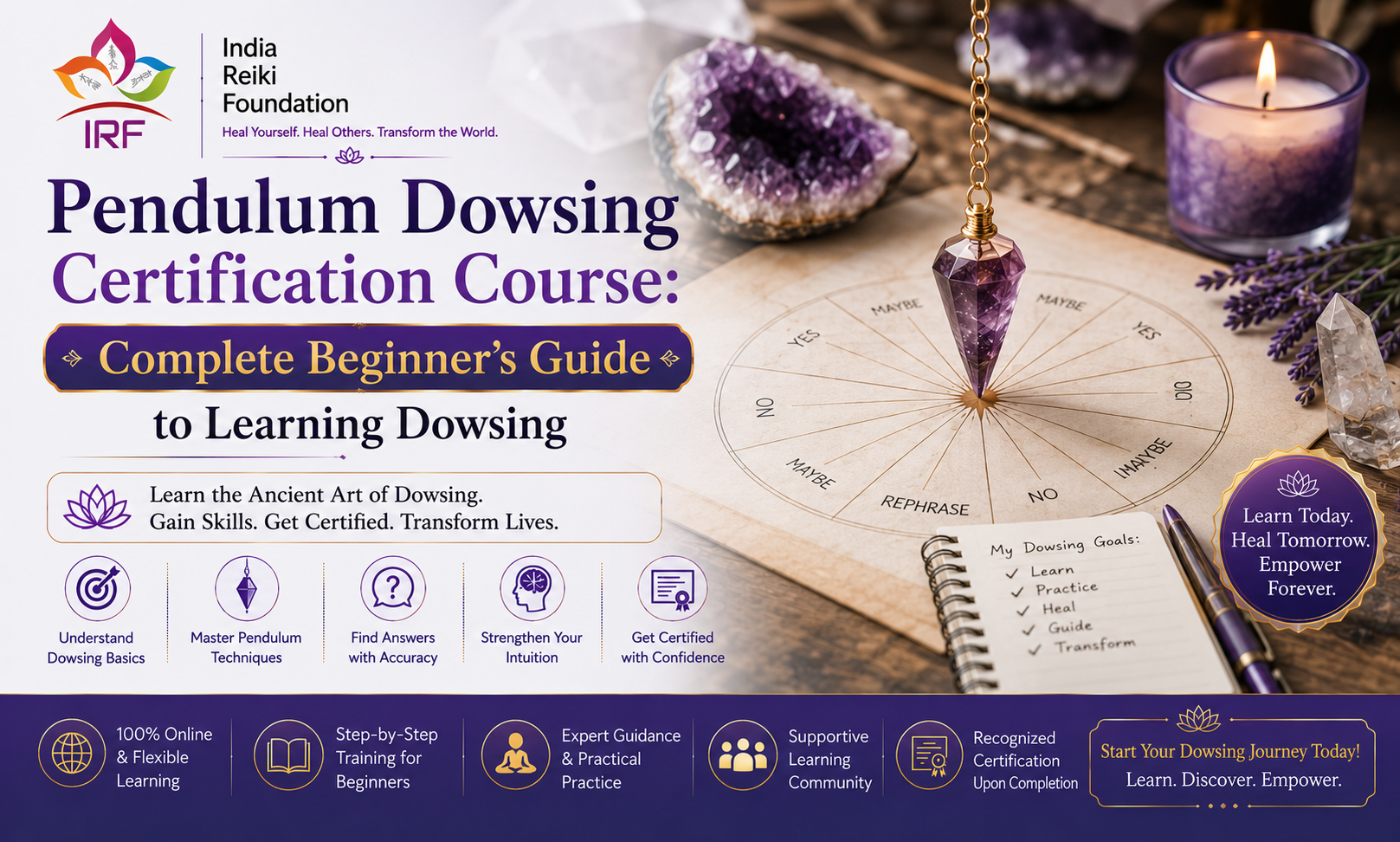
Pendulum dowsing charts provide multiple possible answers rather than limiting the practitioner to basic yes-or-no responses. A chart is commonly designed as a semicircle or circular layout divided into sections. Each section can represent a different answer, number, percentage, letter, chakra, option or category. To use a chart, the practitioner generally positions the pendulum above a central starting point, asks a clearly defined question and observes which section the pendulum moves toward.
For example, a beginner might use a chart containing:
Yes – No – Maybe – Rephrase
More advanced charts might include numbers, percentages, letters or defined categories. Current pendulum resources explain that charts are designed to extend dowsing beyond simple binary questions by providing several possible reference points.
Charts can appear impressive to beginners, but they should usually be introduced after someone becomes comfortable with basic calibration and question framing. A well-structured Pendulum Dowsing Course Online should therefore develop fundamental skills before introducing more detailed chart work.
Why Does a Pendulum Sometimes Give Inconsistent Answers?
Inconsistent answers are one of the most common concerns among beginners. A pendulum may appear to answer “yes” and later produce “no” when the question is repeated. This does not necessarily mean the learner needs a different pendulum. Several factors may contribute to inconsistent results. The question may be vague, contain multiple ideas or depend on circumstances that can change. The practitioner may also be emotionally invested in receiving a particular answer. Physical factors such as hand movement, posture, tiredness and environmental disturbances can also affect what is observed.
Repeatedly asking the same question because you dislike the first response can create additional confusion. Current beginner resources recommend recalibrating when responses become unclear, simplifying the question and avoiding emotionally loaded wording. Taking a break can also be useful. Dowsing practice benefits from patience. Beginners should focus on developing an organized method rather than treating every pendulum movement as an unquestionable answer.
Keeping a dowsing journal can be particularly helpful. Record the question, response, conditions and later outcome where appropriate. Over time, this allows you to evaluate your own consistency rather than depending only on memory.
What Can Pendulum Dowsing Be Used For?
Pendulum dowsing has traditionally been explored for several purposes, ranging from simple yes/no questioning to locating objects and working with spiritual or energetic practices. India Reiki Foundation’s current dowsing curriculum includes finding answers, locating lost or hidden objects, chakra and aura scanning, home scanning, checking the energy of food and integrating dowsing with healing-related practices. People studying dowsing may therefore explore applications such as intuitive questioning, energy awareness, spiritual self-reflection, chakra-related practices, crystal selection and environmental scanning.
Some Reiki practitioners also choose to integrate pendulum work into their broader spiritual education. Someone completing an Online Reiki Course, for example, may later study dowsing to develop another method of observing and exploring energy-related concepts. These applications should remain within reasonable boundaries. Pendulum readings should not be presented as objective scientific measurements or used to diagnose disease, determine medication, replace professional care or make high-stakes decisions without appropriate evidence. Used responsibly, dowsing can instead be treated as a structured intuitive and spiritual practice that encourages observation, reflection and awareness.
What Do You Learn in a Pendulum Dowsing Course?
The exact curriculum differs between training providers, but a professional beginner course should move logically from basic theory to practical application. India Reiki Foundation’s current course curriculum includes an introduction and history of dowsing, different types of dowsers, how dowsing works, connecting and meditating with a dowser, obtaining yes/no responses and finding lost or hidden objects. It also includes chakra and aura scanning using L-shaped dowsers or bobbers, home scanning, food-energy checking, healing-related dowsing, protection tips and some crystal guidance.
This broader curriculum is important because dowsing is not limited to one pendulum exercise. For beginners, a Pendulum Dowsing Course Online should ideally help answer practical questions such as: How should I hold my pendulum? How do I establish responses? How should questions be framed? What happens when an answer is unclear? How can I practise? When should I avoid relying on a reading?
Students with previous Reiki experience may also be interested in understanding the relationship between dowsing and energy work. In this context, a Reiki Healing Course provides education in Reiki methods, while dowsing provides a separate intuitive practice. The two should be understood as related spiritual learning areas rather than treated as identical techniques.
How Do You Choose the Best Pendulum Dowsing Course Online?
Choosing the right course involves more than comparing prices. Begin by examining the curriculum. A beginner-focused course should clearly teach foundational concepts rather than immediately moving into advanced techniques. Look for coverage of pendulum selection, calibration, question formulation, yes/no responses, practical exercises, interpretation and common beginner errors.
You should also consider the teacher or institution’s experience, course structure and whether the material provides enough explanation to help you practise independently. A useful course should explain both what to do and why a particular process is followed. Also consider whether the training matches your learning goal. Someone interested only in basic pendulum use may need a different level of instruction from a Reiki practitioner who wants to combine dowsing with chakra, aura or energy-related practices.
Before enrolling in any Pendulum Dowsing Course Online, review:
- The complete syllabus
- Beginner eligibility
- Practical demonstrations
- Learning format
- Instructor guidance
- Access to course material
- Certification details, where applicable
- Opportunities for further learning
- Clear ethical boundaries around dowsing
If you are also comparing an Online Reiki Course, assess it separately according to the Reiki lineage, levels taught, attunement or placement process, instructor qualifications and course structure.
Can You Learn Pendulum Dowsing Through an Online Course?
Yes. Much of pendulum dowsing can be taught online because the fundamental techniques can be demonstrated visually and practised by the student at home. Online learning is particularly suitable for theory, pendulum positioning, calibration demonstrations, question formulation, chart interpretation and guided exercises. Current online dowsing courses commonly include subjects such as choosing and cleansing a pendulum, programming responses, yes/no questioning, charts and troubleshooting inaccurate or inconsistent responses.
The success of online learning depends heavily on practice. Simply watching lessons is unlikely to develop confidence. Learners should pause demonstrations, repeat exercises and document their observations. A Pendulum Dowsing Course Online can be particularly convenient for students in different parts of India or outside India because the foundational practice does not require travelling to a training centre.
Similarly, people exploring an Online Reiki Course increasingly choose digital learning because it allows them to study theory and guided practices from home. However, students should always check the specific teaching methodology and requirements of the chosen Reiki program rather than assuming every online course follows the same structure.
What Are the Most Common Pendulum Dowsing Mistakes Beginners Should Avoid?
Beginners often focus heavily on what the pendulum is doing while overlooking how they themselves are approaching the session. One common mistake is asking vague questions. Another is asking several things in a single sentence. Questions should be simple and clearly defined. Emotional attachment is another challenge. If you desperately want the pendulum to say “yes,” unconscious movements may influence what you observe. Remaining neutral is therefore an important part of practice.
Other common beginner mistakes include changing pendulums constantly, skipping calibration, interpreting every small movement as meaningful, asking the same question repeatedly, practising while distracted and relying on dowsing for decisions that require professional expertise. Beginners may also rush directly into complicated charts without becoming comfortable with basic yes/no exercises.
Good dowsing practice is not about asking as many questions as possible. It is about developing discipline around how questions are prepared, how responses are observed and how results are interpreted. A systematic course can help learners recognize these issues earlier and develop better habits.
Can You Become a Professional Pendulum Dowser After Completing a Course?
A course can provide foundational knowledge, but becoming a capable professional requires more than completing lessons or receiving a certificate. Someone interested in offering dowsing-related services should continue practising, document their experience, understand ethical boundaries and learn how to communicate responsibly with clients. India Reiki Foundation notes that learners may eventually use dowsing skills professionally as part of dowsing or spiritual consultancy.
However, professional practice should never involve presenting intuitive readings as guaranteed predictions or replacing licensed medical, legal, psychological or financial services. Students who already practise Reiki, crystal healing or other complementary modalities may choose to add dowsing as another skill. For example, someone who has completed a Reiki Healing Course may study dowsing to deepen their understanding of traditional energy-awareness practices. The most responsible professional practitioners maintain clear boundaries about what their service can and cannot provide.
Why Learn Pendulum Dowsing From India Reiki Foundation?
India Reiki Foundation offers spiritual and occult learning across Reiki, crystal healing, numerology, palmistry, Akashic Records and pendulum dowsing, giving learners an environment where dowsing can be understood alongside related spiritual disciplines. Its website currently presents both broader spiritual education and Reiki-focused learning programs. For pendulum learners specifically, the curriculum goes beyond elementary pendulum movements. It includes dowsing fundamentals, history, different dowsing tools, connection and meditation practices, yes/no responses, lost-object work, chakra and aura scanning, home scanning, food-energy checking, healing-related applications, protection tips and crystal guidance.
The course is also positioned for beginners. Reiki is not described as compulsory for learning dowsing, although India Reiki Foundation notes that Reiki Level I may be beneficial for students who intend to combine dowsing with Reiki-related practices. This can make the training particularly relevant for three types of learners: complete beginners who want a structured introduction, spiritual learners who want to understand dowsing systematically, and Reiki practitioners seeking an additional energy-awareness practice.
Students who later want to expand into a Reiki Healing Course or Online Reiki Course can also explore Reiki education within the same broader learning ecosystem. The important advantage of structured learning is not simply receiving information. It is having a logical path from foundational concepts to practical application so that beginners understand how and when different techniques are used.
Frequently Asked Questions About Pendulum Dowsing
1. How Long Does It Take to Learn Pendulum Dowsing?
The fundamental steps of holding, calibrating and asking simple questions can be understood relatively quickly. Developing consistent practice may take considerably longer. Progress depends on how regularly you practise, how carefully you formulate questions and how objectively you review your results.
2. Do I Need Reiki Before Learning Pendulum Dowsing?
No. India Reiki Foundation currently states that anyone can learn dowsing and that Reiki is not essential. Reiki Level I may, however, be helpful for learners who want to combine dowsing with Reiki and energy-healing practices.
3. Can I Use Any Pendulum for Dowsing?
You can practise with many types of balanced weighted pendulums. Crystal, metal and wooden pendulums are commonly used. For beginners, comfortable weight, free movement and consistency are generally more important than choosing a particular material.
4. Do I Need to Cleanse My Pendulum Before Every Session?
Some spiritual practitioners include cleansing as part of their personal ritual, especially when working with crystal pendulums. Methods vary according to the material. Cleansing is a spiritual practice rather than a scientifically required step, so learners can follow the method taught within their chosen dowsing tradition.
5. Why Is My Pendulum Not Moving?
A pendulum may remain still because your grip is too rigid, the question is unclear, the pendulum has not been given enough time to move or normal unconscious muscular movements are minimal. Relax your hand, check your posture, recalibrate and start with simple known-answer questions.
6. Can a Pendulum Predict the Future?
Dowsing traditions sometimes use pendulums to explore possible outcomes, but pendulum responses should not be treated as guaranteed predictions. Future events depend on many changing factors. Dowsing is better approached as an intuitive or spiritual practice rather than a certain method of forecasting events.
7. How Can I Make My Pendulum Answers More Consistent?
Start with clear questions, establish yes/no/maybe signals, remain emotionally neutral and avoid repeatedly asking the same question. Maintaining a practice journal can also help you compare results over time. Current beginner resources consistently emphasize question quality and calibration when discussing consistency.
8. Can I Use Pendulum Dowsing for Chakra Checking?
Chakra-related pendulum work is taught within some spiritual and energy-healing traditions. India Reiki Foundation’s current dowsing curriculum includes chakra and aura scanning using dowsing tools. Such practices should be understood as spiritual energy work and not as medical diagnosis.
9. Is an Online Pendulum Dowsing Course Good for Beginners?
Yes, provided the course starts with fundamentals and includes practical demonstrations, question formulation, response calibration and guided practice. Because pendulum exercises can be performed at home, online instruction can be convenient for complete beginners.
10. Is Pendulum Dowsing the Same as Reiki Healing?
No. They are separate practices. Pendulum dowsing focuses on interpreting movements of dowsing tools within intuitive or energy-related traditions, while Reiki has its own system of energy-healing practices, training levels and attunements or placements depending on the Reiki system. Someone taking an Online Reiki Course may choose to study pendulum dowsing as an additional complementary spiritual skill.
Conclusion: Start Your Pendulum Dowsing Journey With the Right Foundation
Pendulum dowsing may look simple from the outside, but meaningful learning involves much more than watching a pendulum swing. Beginners need to understand how to choose and hold their tool, establish yes/no/maybe responses, formulate precise questions, use charts responsibly, recognize inconsistent readings and practise without allowing expectations to control the process.
A structured Pendulum Dowsing Course Online can provide this foundation in a logical sequence, allowing learners to move from basic concepts toward more detailed applications such as charts, energy awareness, chakra-related practices and different dowsing tools. India Reiki Foundation’s current course curriculum covers introductory and practical dowsing concepts, including yes/no questioning, lost-object work, chakra and aura scanning, home scanning and other energy-related applications. This makes it relevant both to complete beginners and to learners who already have experience with Reiki or related spiritual practices.
If you are exploring pendulum dowsing alongside a Reiki Healing Course or Online Reiki Course, learning each system through structured training can help you understand where the practices connect and where they remain distinct. The goal should not be to depend on a pendulum for every decision. Instead, learn the method carefully, practise consistently, maintain appropriate boundaries and use dowsing as part of a thoughtful approach to spiritual and intuitive development.
India Reiki Foundation | Online Reiki Course & Spiritual Healing Academy
Address- 502–503, Stanford Plaza, Veera Desai Road, Andheri West, Mumbai, Maharashtra 400065, India
Phone number +91 96254 88550
Website- https://indiareikifoundation.com/
Mail- mail@indiareikifoundation.com