Introduction
Human hands are unique. Their shape, fingers, lines, mounts, texture, flexibility, and proportions can vary significantly from one person to another. For centuries, traditional systems of palmistry have studied these differences to understand personality traits, natural tendencies, strengths, emotional patterns, and behavioural characteristics.
Today, anyone interested in this ancient knowledge can begin learning through a Palmistry Course Online. Instead of depending only on books or scattered information, learners can follow a structured approach that explains how to observe a hand, understand its important features, recognise common patterns, and gradually develop interpretation skills. At India Reiki Foundation, palmistry is approached as a systematic field of observation and traditional knowledge. Students are guided step by step so they can understand the hand as a complete structure instead of simply memorising the meanings of individual palm lines.
For beginners, this distinction is important. Palmistry is not only about finding a Life Line, Head Line, or Heart Line and attaching a fixed meaning to it. A meaningful hand reading involves examining the overall palm, fingers, thumb, mounts, skin texture, flexibility, and lines together. This guide explains the fundamental concepts that can help you begin your palmistry learning journey with greater clarity and confidence.
What Is Palmistry?
Palmistry is the traditional practice of studying the physical characteristics of the hands to understand different aspects of an individual’s nature and behaviour. It involves observing the structure of the palm, fingers, thumb, mounts, major and minor lines, markings, flexibility, and other visible characteristics.
A trained palmist does not normally depend on one feature alone. For example, a particular line may appear similar on two different hands, but the overall interpretation can change according to the palm shape, fingers, mounts, thumb, and other surrounding characteristics. This is why professional learning places strong emphasis on observation and comparison. A structured Palmistry Course Online helps beginners understand how individual characteristics work together and how to develop an organised method for examining a hand.
Where Did Palmistry Originate?
Palmistry has a long history and has been studied in different forms across several ancient cultures. India has an important place in the development of traditional hand analysis. References to physical characteristics, including the hands, are associated with Samudrika Shastra, an ancient system concerned with observing the features of the human body and understanding their traditional significance.
Over time, knowledge related to hand reading travelled through different regions and cultures. Variations of palmistry became known in places such as China, Persia, Greece, and parts of Europe. Different traditions developed their own interpretations, terminology, and teaching methods. However, the central practice remained largely similar: observing the hand carefully and studying its different characteristics as part of an interconnected system. Today, this traditional subject has become much easier to access because learners can study it through live digital classes and guided online programs.
Can Beginners Learn Palmistry Online?
Yes. Beginners can learn palmistry online when the training follows a clear and progressive learning structure. You do not have to understand palm lines or know traditional terminology before joining a beginner-level course. The learning process can begin with very basic concepts such as palm structure, hand shape, finger length, thumb formation, and elemental classification. Once these foundations are understood, students can gradually move toward mounts, major lines, minor lines, special markings, combinations, and practical interpretation. A beginner-friendly Palmistry Course Online can therefore make the subject easier to understand because learners are not expected to memorise everything at once. The purpose is to build knowledge gradually and strengthen observation through repeated practice.
Why Should You Learn the Structure of the Hand First?
One of the most common beginner mistakes is to start directly with palm lines. Lines are certainly important, but they represent only one part of the hand. Before interpreting them, students should first understand the overall structure because palm shape, fingers, thumb, skin texture, mounts, and flexibility provide important supporting information. A good palmistry reading usually begins with the larger characteristics and gradually moves toward smaller details. This helps the learner avoid making an interpretation based on one isolated feature.
Understanding Palm Shape in Palmistry
The palm provides the basic framework for hand analysis. Beginners are taught to notice whether the palm appears broad, narrow, long, short, square, rectangular, soft, firm, balanced, or disproportionate. The relationship between the length of the palm and the fingers is also observed. Instead of looking at each characteristic independently, students learn to consider how the shape of the palm fits with the rest of the hand. With regular practice, recognising different palm structures becomes easier and creates a foundation for more detailed interpretation.
Understanding the Five Elements of the Hand
Traditional palmistry frequently connects different hand structures with elemental qualities. These classifications help learners identify broad patterns before moving into detailed analysis.
Earth Hands
Earth-related characteristics are traditionally connected with stability, practicality, patience, consistency, and a realistic approach to everyday situations. People with strong Earth characteristics may prefer structure, reliability, and practical decision-making.
Air Hands
Air characteristics are commonly associated with intellectual curiosity, communication, learning, analysis, and mental activity. Such individuals may enjoy exchanging ideas, gathering information, discussing concepts, and solving problems.
Fire Hands
Fire characteristics are traditionally associated with enthusiasm, ambition, confidence, action, and initiative. People showing dominant Fire qualities may naturally prefer movement, challenges, leadership, or environments where they can express their energy.
Water Hands
Water characteristics are generally linked with emotional awareness, imagination, creativity, sensitivity, intuition, and empathy. These characteristics may be noticeable in people who respond strongly to feelings, artistic expression, and emotional connections.
Ether Element
Some palmistry traditions also include Ether or Akasha as an additional element associated with spiritual awareness, deeper understanding, wisdom, and higher consciousness. The terminology and interpretations may differ between schools, but elemental classification provides beginners with a useful starting framework.
Why Are Fingers Important in Palmistry?
Fingers form an essential part of hand analysis. A student does not simply look at whether a finger is long or short. Several features are considered together, including finger length, shape, spacing, flexibility, position, proportion, and relationship with neighbouring fingers. These details can provide supporting information about behavioural tendencies and personality patterns within traditional palmistry. Beginners should avoid interpreting a single finger independently. Professional observation involves connecting finger characteristics with the palm, thumb, mounts, and lines. This combined approach creates a more balanced reading.
The Importance of the Thumb in Hand Reading
The thumb receives special attention in palmistry because of its unique structure and movement. Students learn to observe its length, flexibility, angle, placement, shape, and proportions. Traditional interpretations often connect the thumb with qualities such as willpower, practical thinking, adaptability, determination, and decision-making. However, the thumb should never be read in isolation. Its interpretation becomes more meaningful when compared with the rest of the hand.
What Are Mounts in Palmistry?
Mounts are the slightly raised or fleshy regions located across different areas of the palm. Traditional palmistry associates these areas with different qualities and planetary symbolism. When learning about mounts, students observe whether a particular area appears balanced, prominent, flat, firm, soft, or comparatively developed. The objective is not simply to identify the largest mount. Instead, learners study the relative balance between different parts of the palm. A Palmistry Course Online generally introduces mount analysis after students have developed familiarity with the general structure of the hand.
What Are the Major Lines in Palmistry?
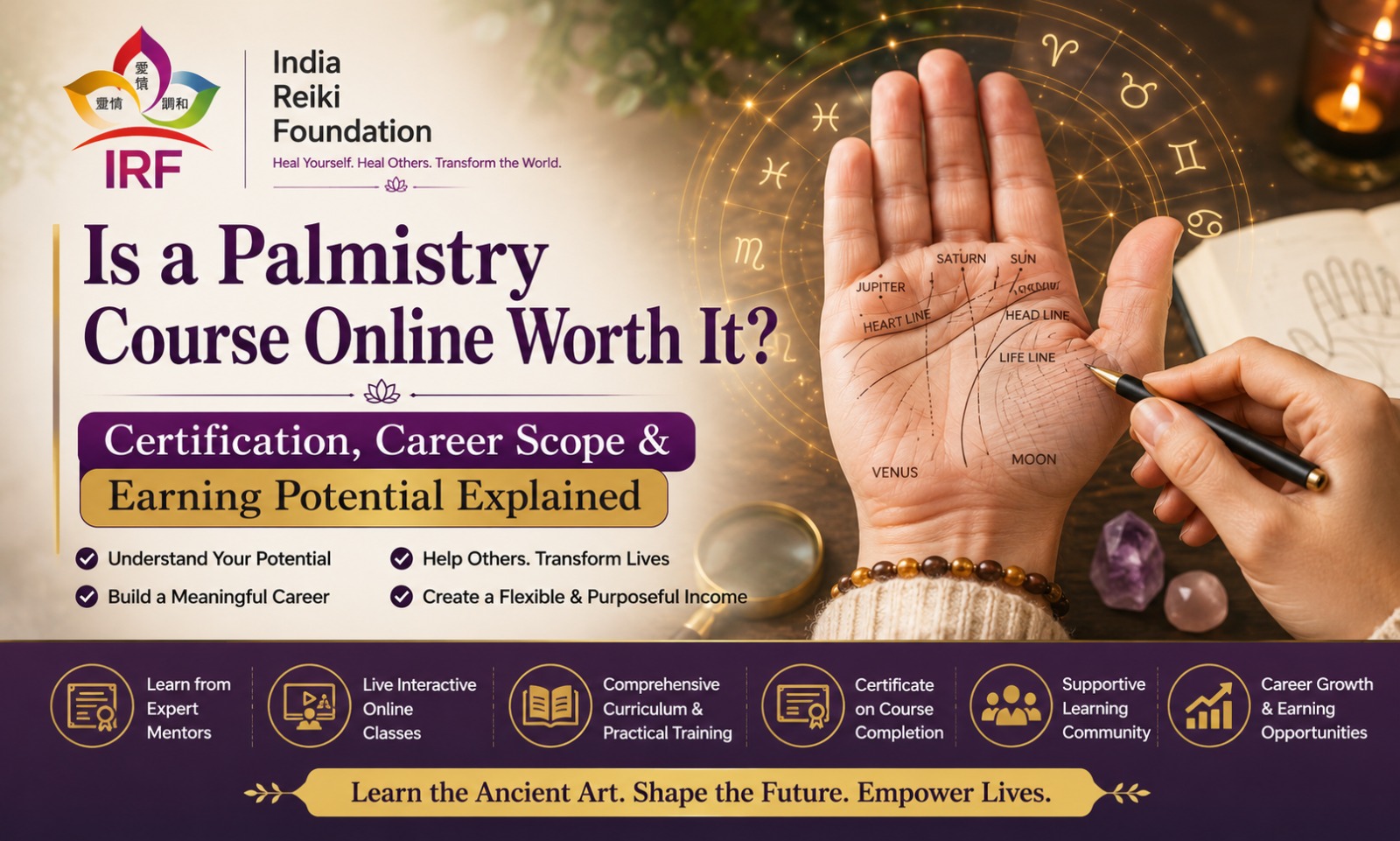
Once the hand’s basic structure has been observed, students can begin studying the major palm lines. The most commonly discussed lines include the Life Line, Head Line, Heart Line, and Fate Line.
Life Line
The Life Line is one of the most recognised features in palmistry. Students learn to observe its formation, depth, clarity, direction, breaks, branches, and relationship with surrounding markings. A common misconception is that the length of the Life Line directly determines lifespan. Responsible palmistry education avoids making such simplistic or fear-based interpretations.
Head Line
The Head Line is traditionally studied in relation to thinking patterns, mental approach, decision-making, concentration, and intellectual tendencies. Its direction, formation, length, clarity, and relationship with other features are considered during analysis.
Heart Line
The Heart Line is associated with emotional expression, relationships, sensitivity, and interpersonal tendencies in traditional palmistry. Its overall formation is considered alongside the complete hand rather than interpreted through one isolated characteristic.
Fate Line
The Fate Line is another important line studied in many palmistry traditions. Its presence, absence, direction, strength, and relationship with other palm lines may be examined as part of the larger analysis. Not every person has an identical Fate Line, which is one reason students need practical exposure to many different hands.
Are Minor Lines and Markings Important?
After gaining confidence with major lines, learners can move toward smaller lines, branches, crosses, breaks, intersections, and other markings. These details may provide additional information, but they should generally be treated as supporting features. Beginners sometimes become overly focused on unusual symbols or markings they discover online. This can result in exaggerated interpretations. A structured course teaches students to first understand the overall hand and major features before giving importance to minor details.
How Do Professional Palmists Examine a Hand?
An organised hand-reading process makes interpretation more consistent. A professional approach usually begins with a broad observation and gradually moves toward smaller details. First, observe the complete hand. Notice its general shape, proportion, flexibility, texture, and overall appearance. Next, study the fingers. Compare their length, spacing, flexibility, and shape. Then examine the thumb and consider its placement, proportions, and movement. After this, observe the mounts and compare their relative development. Only then should you begin studying the major palm lines and supporting markings. Finally, connect all observations before forming an interpretation. This sequence reduces the possibility of drawing conclusions from a single characteristic.
How Can You Practise Palmistry as a Beginner?
Palmistry improves through observation. Studying theory is important, but practical exposure helps students recognise how different features actually appear on real hands. One effective method is to observe your own hands first. This gives you time to identify structures, fingers, mounts, and lines without pressure. After that, you can practise with family members or friends after taking their permission. Instead of trying to give a complete reading immediately, focus on identifying what you see. For example, ask yourself whether the palm is long or broad, whether the fingers are flexible, whether the thumb opens widely, which mounts appear prominent, and how clearly the major lines are formed. This builds visual familiarity.
Keep a Palmistry Learning Journal
Maintaining written observations can accelerate your learning. You can record information such as the date, palm structure, dominant hand, finger characteristics, thumb formation, mounts, major lines, unusual markings, questions, and interpretations discussed during your classes. Over time, the journal becomes a valuable personal reference. It also allows you to review earlier observations and compare how your understanding develops with continued study.
Compare Different Hands Instead of Memorising Meanings
Comparison is one of the most useful exercises for beginners. Study several hands and notice how the same feature can appear differently. Compare thumb flexibility, finger proportions, palm width, major lines, and mount development across different people. This helps you understand that palmistry is not simply a collection of fixed definitions. Practical observation teaches you to recognise relationships between features. The more hands you examine, the easier pattern recognition becomes.
Palmistry Is More Than Future Prediction
Palmistry is often associated with predicting future events, but this is only one popular perception of the subject. A more balanced approach focuses on understanding tendencies, behavioural patterns, strengths, communication styles, emotional characteristics, and other traditional interpretations reflected through the hand. Absolute statements about future events can create unnecessary fear or unrealistic expectations. For this reason, responsible palmistry education encourages thoughtful interpretation rather than sensational predictions. At India Reiki Foundation, students are encouraged to approach the subject with respect, observation, sensitivity, and responsible communication.
Can Palmistry Help With Self-Awareness?
One of the reasons many people become interested in palmistry is self-exploration. Learning to observe the hand carefully encourages patience and attention to detail. Students also begin thinking more deeply about behavioural tendencies, strengths, habits, communication styles, and personal patterns. The learning experience can therefore extend beyond simply identifying lines. It may encourage greater awareness of how different people think, communicate, and respond to situations. This is also why some students interested in palmistry explore other holistic subjects.
Palmistry Course Online and Reiki Course Online
Palmistry and Reiki are separate disciplines, but people interested in holistic learning often study both. Palmistry primarily focuses on observing the hand and understanding traditional interpretations connected with personality and behavioural tendencies. A Reiki Course Online focuses on Reiki practices, energy awareness, relaxation, and holistic well-being. Learning both can provide students with different perspectives. Palmistry develops observation and analytical thinking, while Reiki introduces learners to energy-based practices and inner awareness. India Reiki Foundation offers learning opportunities across these and several other holistic disciplines for students interested in expanding their knowledge.
Palmistry vs Astrology vs Numerology
Palmistry, astrology, and numerology are frequently studied by people who are curious about traditional systems of self-understanding, but each uses a different method. Palmistry uses the hand as its primary area of observation. Astrology uses birth information and planetary positions to study traditional astrological patterns. Numerology works with numbers associated with names, dates, and other numerical relationships. Students do not necessarily need to choose only one subject. Many learners begin with the field they find easiest to understand and later expand into complementary areas.
What Skills Can You Develop While Learning Palmistry?
Palmistry learning involves more than remembering terminology. Students gradually develop stronger observational abilities because they must notice small differences between hands. Analytical thinking improves as they begin comparing multiple characteristics instead of relying on single features. Communication skills also become important because interpretations should be explained clearly and thoughtfully. Regular practice can further strengthen patience, concentration, listening, and pattern recognition. These abilities can be valuable even outside the study of palmistry.
How to Choose the Best Palmistry Course Online
Not every online course follows the same teaching method, so learners should examine the program carefully before enrolling. Look for a course that starts with beginner concepts and gradually progresses toward deeper interpretation. Experienced guidance is particularly valuable because students often develop questions when they begin examining real hands.
Live classes can make the learning process more interactive by allowing learners to ask questions, participate in discussions, and understand practical examples. Practical demonstrations are equally important. Seeing how a teacher studies a real hand often makes concepts much easier to understand than reading definitions alone. Students should also consider whether the institute provides learning support and encourages responsible interpretation.
Why Learn Palmistry with India Reiki Foundation?
India Reiki Foundation provides structured learning for students interested in traditional and holistic disciplines. The Palmistry Course Online is designed to help learners progress systematically instead of depending on scattered information. Students can learn through beginner-friendly explanations, guided instruction, practical demonstrations, live interaction, and opportunities to clarify their doubts.
The focus is on helping learners understand the entire hand rather than memorising isolated signs. India Reiki Foundation also offers courses in Reiki, Crystal Healing, Numerology, Astrology, Pendulum Dowsing, Akashic Records, and other holistic subjects, allowing students to continue expanding their knowledge according to their interests.
Frequently Asked Questions About Palmistry Course Online
Can I learn palmistry without previous experience?
Yes. Beginners can start learning palmistry without previous knowledge. A structured course begins with basic hand observation before moving toward lines, mounts, markings, and detailed interpretation.
Can palmistry be learned completely online?
Online learning can be effective when it includes guided lessons, demonstrations, interaction with instructors, practical exercises, and regular observation of different hands.
How long does it take to become confident in palmistry?
There is no single fixed period because confidence depends on how regularly you study and practise. Observing different hands and revising your concepts consistently can help improve your understanding.
Do I need to memorise every palm line?
No. Memorisation alone is not enough. Palmistry requires understanding how different characteristics relate to one another and learning how to observe patterns across the complete hand.
Which hand should beginners read?
Palmistry traditions may use dominant and non-dominant hands differently. During proper training, students learn how both hands can be compared and how their observations should be interpreted according to the method being followed.
Can I learn palmistry and Reiki together?
Yes. Students interested in holistic learning may study both. Palmistry focuses on hand observation and interpretation, while Reiki focuses on energy-awareness practices and holistic well-being.
Is palmistry only about predicting the future?
No. Palmistry can also be approached as a traditional method for exploring personality traits, behavioural tendencies, strengths, emotional patterns, and natural characteristics.
What is the best way to practise palmistry?
Observe as many different hands as possible with permission. Keep notes, compare features, review your lessons, and avoid rushing into interpretations before understanding the complete hand.
Does India Reiki Foundation provide online palmistry training?
India Reiki Foundation offers online learning designed to guide students from fundamental concepts toward practical palmistry understanding with structured teaching and guidance.
What can I study after completing a Palmistry Course Online?
You can continue practising palmistry and explore related disciplines such as Reiki, Numerology, Astrology, Crystal Healing, Pendulum Dowsing, and other holistic sciences according to your interests.
Conclusion
Learning palmistry is not simply about memorising what individual lines are believed to mean. It is about developing the ability to observe the hand carefully, understand its different characteristics, identify relationships between features, and gradually create a balanced interpretation. A structured Palmistry Course Online can help beginners build these skills step by step. Starting with hand shapes and elemental classifications, learners can gradually understand fingers, thumbs, mounts, major lines, minor markings, and practical reading techniques. Regular practice plays an important role in this journey. Every new hand provides another opportunity to compare, observe, question, and improve your understanding. At India Reiki Foundation, learners can explore palmistry through guided online education while also expanding into Reiki and other holistic sciences. Whether you want to study palmistry for personal knowledge, self-exploration, or to develop a deeper understanding of traditional hand reading, the right foundation can help you learn with greater clarity and confidence.
Begin your Palmistry Course Online with India Reiki Foundation and take your first step toward understanding the ancient art of hand reading.
India Reiki Foundation | Online Reiki Course & Spiritual Healing Academy
Adress- 502-503, Stanford Plaza, Veera Desai Road, Andheri West, Mumbai, Maharashtra 400065, India
Phone number +91 96254 88550
Website- indiareikifoundation.com
Mail- mail@indiareikifoundation.com