Learning Reiki is not simply about completing a course or collecting a certificate. It is a progressive journey in which each level develops a different aspect of understanding, self-practice, energy awareness and, eventually, the ability to work with others or teach Reiki. For someone researching a Holy Fire Reiki Course Online, understanding this progression before enrolling can make it much easier to choose the right starting point and know what to expect at every stage.
Holy Fire Reiki was introduced by William Lee Rand in 2014 and developed as a contemporary Reiki system that uses Experiences, Placements and Ignitions within its training structure. India Reiki Foundation currently teaches the journey through combined Holy Fire Reiki Level I & II Training followed by Holy Fire Reiki Level III & Masters Training. Level I and II build the practitioner foundation, while Level III and Masters move into advanced Reiki practice, the Master Symbol, Holy Fire practices and teaching methodology.
For learners comparing a Reiki Healing Course, an Online Reiki Course, or advanced Reiki Master training, this guide explains the complete learning roadmap from beginner level to Master. Reiki should be understood as a complementary spiritual and wellness practice and should not be used as a substitute for professional medical diagnosis, treatment or mental-health care.
What Is Holy Fire Reiki and How Does It Work?
Holy Fire Reiki is a modern form of Reiki that builds on the broader Usui Reiki tradition while using a distinct training process involving guided Experiences, Placements and Ignitions. Within Reiki teachings, practitioners understand Reiki as universal life-force energy and use structured practices, meditation, intention and hand positions as part of personal and practitioner-level sessions.
One of the defining differences in Holy Fire Reiki training is its terminology and initiation process. Instead of relying only on the traditional concept of hands-on attunements, the Holy Fire system uses Placements during earlier levels and Ignitions within advanced Master training. ICRT’s current class descriptions likewise identify Placements within Reiki I and II and Master Placements and Ignitions within Master-level education.
A structured Holy Fire Reiki Course Online may therefore include:
- Reiki principles and history
- Self-Reiki and energy awareness
- Reiki hand positions
- Meditation and guided Experiences
- Reiki symbols
- Distance Reiki
- Placements and Ignitions
- Advanced Master-level practices
- Teaching methodology
- Ethical practitioner and teacher responsibilities
The purpose of progressing through these elements gradually is to give students enough time to understand and practise each level rather than treating Reiki Mastership as a shortcut.
Can Beginners Learn Holy Fire Reiki Online?
Yes. Beginners can start Holy Fire Reiki without previous Reiki experience when they begin with the foundational level rather than attempting to enter an advanced stage immediately. India Reiki Foundation identifies its Level I & II program as suitable for beginners as well as existing practitioners interested in studying the Holy Fire system.
A beginner-friendly Online Reiki Course should first explain the foundations clearly. Students need to understand concepts such as Reiki principles, self-practice, energy awareness, aura, chakras, grounding, hand positions and appropriate boundaries before advanced symbols or teaching methods become relevant.
A beginner should ideally start by learning:
- What Reiki is and how Reiki practice is traditionally understood
- The difference between self-Reiki and practising with others
- Basic hand positions
- Grounding and energy hygiene
- Reiki principles and meditation
- Consent and boundaries
- How to maintain a regular personal practice
- When and how to progress to the next level
The goal at the beginning should not be to become a Master as quickly as possible. A good Reiki Healing Course allows knowledge, practice and confidence to develop progressively.
What Are the Different Levels of Holy Fire Reiki Training?
Holy Fire Reiki training moves from foundational practitioner education toward advanced practice and teaching. India Reiki Foundation currently organizes its Holy Fire pathway into Level I & II as a combined foundational course and Level III & Masters as the advanced Master-level program.
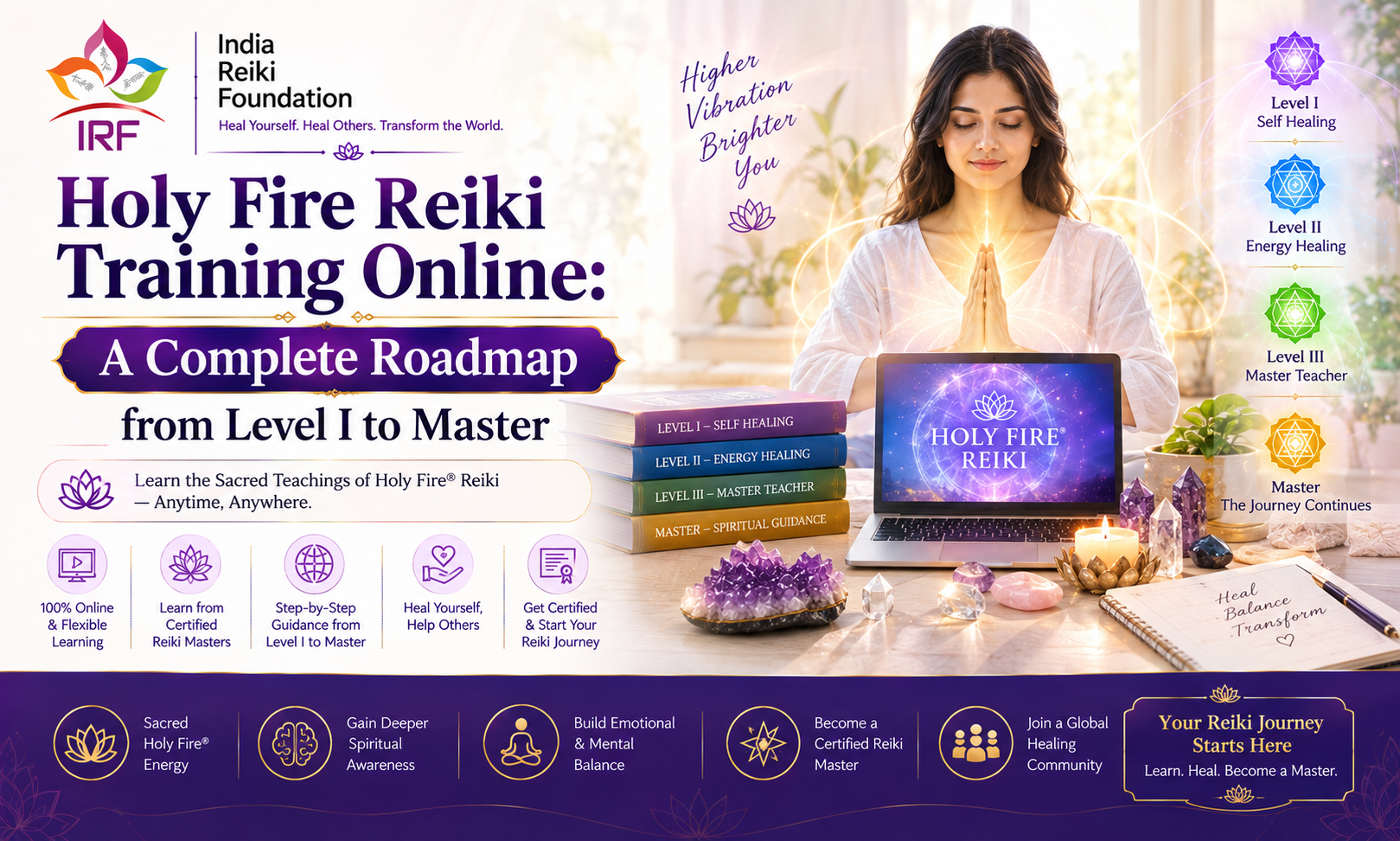
Each stage has a different learning purpose. Level I concentrates largely on understanding Reiki and developing self-practice. Level II introduces symbols, working with others and distance Reiki. Level III moves into Master-level concepts and the Master Symbol, while Master training expands the learner’s role into conducting Placements, Ignitions and classes for future students.
The roadmap can be understood as:
- Level I: Reiki foundations, self-practice and basic application
- Level II: Reiki symbols, practice with others and distance Reiki
- Level III: Advanced Reiki practice and the Master Symbol
- Master Level: Placements, Ignitions, teaching methodology and student guidance
This step-by-step structure is important because each stage prepares the learner for responsibilities introduced at the next.
What Is Included in Holy Fire Reiki Level I & II Training Online?
Holy Fire Reiki Level I & II creates the foundation for both personal Reiki practice and later practitioner development. India Reiki Foundation currently offers the two levels together as a two-day program, with approximately four to five hours of learning per day and options including online Zoom training, in-person learning and retreat formats.
Level I begins with Reiki fundamentals and self-practice. Level II then expands the learner’s understanding through symbols, emotional and mental applications, working with others and distance Reiki. This progression makes Level I and II an important foundation before advanced Master-level study.
Key areas covered during Level I & II include:
- Origin and principles of Reiki
- Understanding energy, aura and chakras
- Reiki hand positions
- Self-Reiki practice
- Grounding and energy hygiene
- Guided Holy Fire meditation and Experiences
- Reiki II symbols
- Practice with other people
- Distance Reiki
- Emotional and mental Reiki applications
- Energy-clearing practices
- Practical guidance for conducting Reiki sessions
India Reiki Foundation also states that its Level I & II program includes study material and practitioner certification after completion.
For someone choosing their first Holy Fire Reiki Course Online, this foundational program answers the most important early questions before moving toward advanced techniques.
What Reiki Symbols Are Taught in Holy Fire Reiki Level II?
Holy Fire Reiki Level II introduces three Reiki symbols generally described as the Power, Harmony and Distance symbols within India Reiki Foundation’s curriculum. Learners are taught how the symbols fit into Reiki practice and how they may be applied within sessions and distance Reiki.
Symbols should not be viewed simply as information to memorize. In structured Reiki education, the student learns their purpose, appropriate use and how they relate to the wider practice. ICRT’s Reiki I & II curriculum similarly includes teaching students how to draw, activate and practise with the Reiki II symbols.
Level II symbol training commonly explores:
- Using the Power symbol within Reiki practice
- Using the Harmony symbol in mental and emotional-focused practice
- Using the Distance symbol for distant Reiki
- Drawing and activating symbols correctly
- Integrating symbols into a complete Reiki session
- Understanding the intention associated with each symbol
- Practising consistently rather than relying on memorization alone
This is one reason Level II represents an important transition from introductory learning toward broader practitioner applications.
What Is Distance Reiki and When Is It Introduced in the Course?
Distance Reiki refers to the Reiki practice of directing a session toward a person or situation without requiring the practitioner and recipient to be physically in the same location. Within Holy Fire Reiki training, distance Reiki is introduced at Level II, alongside the Distance symbol and other Level II practices.
India Reiki Foundation specifically includes distant healing and sending Reiki across time and space within its Level II curriculum. Current ICRT Reiki I & II training descriptions also include distant Reiki as part of second-level instruction.
During distance Reiki training, students may learn:
- The role of the Distance symbol
- How to prepare for a distance Reiki practice
- How intention is incorporated into a session
- How to maintain focus during practice
- Appropriate consent and boundaries
- How distance Reiki differs from in-person hand-position practice
Distance Reiki is based on Reiki’s spiritual framework and should not be presented as scientifically proven remote medical treatment. Responsible practitioners should maintain clear boundaries between spiritual wellness practice and healthcare.
How Much Practice Is Recommended After Holy Fire Reiki Level I & II?
There is no single universal number of practice days that automatically makes someone an experienced Reiki practitioner. What matters more is regular, intentional self-practice and enough practical experience to become comfortable with the techniques introduced during Level I and II.
After completing a Reiki Healing Course, students benefit from spending time integrating what they have learned before focusing only on the next certificate. This can include regular self-Reiki, meditation, symbol practice, supervised or consent-based practice with others and reflection on how to conduct sessions responsibly.
Useful post-training practice can include:
- Maintaining consistent self-Reiki
- Reviewing Reiki principles
- Practising hand positions
- Becoming comfortable drawing and using Level II symbols
- Practising distance Reiki
- Revisiting course notes and guided meditations
- Developing appropriate session boundaries
- Recording questions for the teacher
- Practising with willing friends or family where appropriate
The aim should be familiarity and integration rather than rushing through levels simply to reach Master certification.
When Are You Ready to Progress to Holy Fire Reiki Level III?
A learner is generally better prepared for Level III when the foundations from Level I and II feel familiar rather than new. You should understand basic Reiki practice, feel comfortable using the Level II symbols and have enough practical experience to appreciate why Master-level training carries additional responsibility.
Readiness is therefore partly about course eligibility and partly about personal preparation. India Reiki Foundation describes its advanced training as suitable for qualified practitioners progressing beyond the foundational stage, including Holy Fire Level II practitioners and experienced Reiki practitioners seeking advanced Holy Fire education.
Signs you may be ready for advanced training include:
- You regularly practise Reiki
- You understand the Level II symbols
- You are comfortable with self-Reiki
- You understand distance Reiki
- You have practised responsibly with others
- You want to deepen your spiritual practice
- You are interested in advanced Reiki rather than only certification
- You may eventually want to teach Reiki
Master-level study should ideally represent a deeper commitment to learning, practice, ethics and teaching responsibility.
What Is Covered in Holy Fire Reiki Level III & Masters Training Online?
Holy Fire Reiki Level III & Masters moves beyond foundational practitioner education into advanced Reiki practice and preparation for teaching. India Reiki Foundation describes its current Level III & Masters program as a three-to-four-day training format available online and offline.
The advanced curriculum includes the Usui Master Symbol, Holy Fire Experiences, Master Placements and Ignitions, advanced practice, student guidance and instruction in how to conduct the Holy Fire system for others. The program therefore serves learners who want both deeper personal study and Master Teacher preparation.
Major areas covered include:
- Holy Fire Experiences and guided meditation
- Master-level Reiki practice
- The Usui Master Symbol, Dai Ko Myo
- Master Placement
- Holy Fire symbol
- Master Ignitions
- Advanced Reiki applications
- Reiki crystal-grid practice
- Conducting Placements and Ignitions
- Teaching Reiki levels
- Structuring Reiki classes
- Ethical student and client management
- Master Teacher certification
The curriculum represents a significant step beyond simply learning another technique. It begins preparing the practitioner to guide other learners responsibly.
What Are Placements and Ignitions in Holy Fire Reiki Training?
Placements and Ignitions are terms used within Holy Fire Reiki for processes that fulfil the role traditionally associated with Reiki attunements. Placements are used within Reiki I, II and parts of advanced training, while Ignitions are particularly associated with Master-level Holy Fire training.
ICRT explains that the Holy Fire system uses Placements for Reiki I and II and a series of Master-level Ignitions within advanced training. The India Reiki Foundation curriculum likewise includes Placements and Ignitions as central components of the Holy Fire learning process.
In simple terms:
- Placement: Used to introduce or strengthen the student’s connection within particular stages of Holy Fire Reiki training.
- Master Placement: Introduced during advanced training and associated with empowerment of the Usui Master symbol.
- Ignition: A Master-level process within the Holy Fire system.
- Experiences: Guided meditative practices incorporated throughout Holy Fire Reiki training.
Because these concepts are experiential and tradition-specific, they are best learned with proper guidance rather than through isolated descriptions found online.
What Is the Difference Between a Reiki Practitioner and a Reiki Master?
A Reiki practitioner primarily learns how to practise Reiki for themselves and, depending on their training level, with other people. A Reiki Master has completed advanced training that goes beyond practitioner techniques and may include Master-level symbols, Placements, Ignitions and the preparation required to teach Reiki.
The difference therefore involves responsibility as much as technique. A person who completes Level II may develop practitioner skills, whereas Master Teacher education prepares someone to guide students through Reiki training and its initiation processes.
A Reiki practitioner typically focuses on:
- Self-Reiki
- Reiki sessions
- Hand positions
- Level II symbols
- Distance Reiki
- Appropriate practitioner boundaries
A Reiki Master Teacher additionally learns:
- Master-level symbols
- Placements and Ignitions
- Advanced Reiki Experiences
- Teaching methodology
- Student guidance
- Class structure
- Ethical responsibilities of teaching Reiki
Mastership should therefore be viewed as advanced education and responsibility rather than merely a higher title.
Do You Need Level I and II Before Joining Holy Fire Reiki Master Training?
For a complete beginner, the appropriate path is to develop a Reiki foundation before progressing to Master training. Levels build on one another, and Master-level education assumes that the learner already understands practitioner-level Reiki and the Level II symbols.
Eligibility can differ depending on the school, teacher and previous Reiki lineage. India Reiki Foundation specifically identifies Holy Fire Level II practitioners among the learners suited to its advanced program, while ICRT states that its current Holy Fire Master training accepts learners with Reiki II or higher from a Reiki lineage.
This means experienced practitioners coming from another Reiki background may have a different route from complete beginners. Before enrolling, students should provide their existing training history and confirm eligibility directly with the course provider.
Can You Become a Certified Holy Fire Reiki Master Online?
Yes, Holy Fire Reiki Master training is currently offered online by established Reiki training organisations. Both India Reiki Foundation and ICRT currently describe online Holy Fire Master training formats. India Reiki Foundation states that successful completion of its Level III & Masters program leads to Holy Fire Reiki Level III & Master Teacher certification.
However, students should examine more than the word “certificate.” A high-quality Online Reiki Course should explain the curriculum, teacher’s background, learning format, practical components, certification level and what the qualification is intended to represent.
Before enrolling, ask:
- Who teaches the course?
- What Reiki lineage or training background do they have?
- Are the classes live or prerecorded?
- How are Placements and Ignitions conducted?
- Is practice included?
- What study material is provided?
- What level appears on the certificate?
- Does Master training include teaching methodology?
- Is post-course guidance available?
These questions help distinguish comprehensive training from a course that provides little more than a certificate.
How Long Does It Take to Complete Holy Fire Reiki Training from Level I to Master?
The scheduled classroom portion can be completed relatively quickly, but developing as a practitioner naturally takes longer. At India Reiki Foundation, Level I & II is currently structured as a two-day intensive program, while Level III & Masters is described as a three-to-four-day advanced program.
That does not mean someone should think of the entire Reiki journey as only five or six days. Training hours and personal integration are different things. Meaningful learning includes practice between stages, revisiting techniques, gaining confidence and developing the maturity required for advanced or teaching responsibilities.
The better question is therefore not simply, “How fast can I become a Reiki Master?” but “How well have I understood and integrated each level before progressing?”
Is Online Holy Fire Reiki Training as Effective as In-Person Training?
Online and in-person training can both provide structured Reiki education, but the quality depends heavily on how the program is delivered. Online Holy Fire Reiki education is now an established format within organisations such as ICRT, and India Reiki Foundation currently offers its foundational and advanced Holy Fire programs through online formats as well.
For many students, online learning offers practical advantages such as geographic accessibility, reduced travel and the ability to train with a specific teacher regardless of location. However, learners should still expect interaction, instruction, guided practice and opportunities to ask questions.
A strong online Reiki program should provide:
- Live teacher interaction where possible
- Structured curriculum
- Guided Reiki Experiences
- Placements or Ignitions appropriate to the level
- Practical demonstrations
- Opportunities for questions
- Study materials
- Clear progression between levels
- Appropriate certification
- Guidance about ethical practice
Online learning should not mean learning without guidance.
Can a Holy Fire Reiki Master Teach Reiki to Others?
Yes, Master Teacher training is specifically designed to prepare qualified practitioners to guide other Reiki students. India Reiki Foundation states that its Holy Fire Reiki Master program covers conducting Placements, Ignitions and meditations, class structure and student management. Its course describes completion as preparing learners for the Holy Fire Reiki Master Teacher role.
ICRT’s current Holy Fire Reiki Master training similarly states that graduates are prepared to teach Reiki classes and initiate students through Reiki levels.
Teaching Reiki, however, involves more than repeating a manual. A responsible teacher should understand the practices deeply, communicate clearly, respect boundaries, avoid unsupported medical claims and know when a student’s concern should be referred to an appropriate professional.
What Should You Look for in a Holy Fire Reiki Course Online?
The best Holy Fire Reiki Course Online is not necessarily the fastest or the cheapest. Learners should look for a course with transparent teaching credentials, structured level progression, guided practical training and clear information about certification.
A reliable program should also explain what happens during each level rather than promising instant mastery. Since Reiki education includes experiential practice, interaction with the teacher and opportunities to clarify techniques can be valuable.
Before choosing an Online Reiki Course, evaluate:
- Teacher training and Reiki lineage
- Exact Reiki system being taught
- Eligibility requirements
- Course duration
- Live versus recorded format
- Level-specific curriculum
- Reiki symbols included
- Placements and Ignitions
- Practical session training
- Distance Reiki training
- Course manuals or learning resources
- Certification provided
- Support after training
- Ethical and professional guidance
- Clear policies about Reiki as a complementary practice
This type of comparison helps learners choose an appropriate Reiki Healing Course instead of making a decision based only on promotional claims.
Why Learn Holy Fire Reiki Online with India Reiki Foundation?
India Reiki Foundation offers a structured progression for learners who want to study Holy Fire Reiki from foundational practitioner training through Master Teacher education. Its current pathway combines Level I & II as the initial program and Level III & Masters as the advanced stage, allowing learners to follow a clear sequence rather than approaching the system in disconnected modules.
The Level I & II course includes self-practice, energy concepts, Reiki techniques, Level II symbols and distance Reiki, while advanced training covers the Master Symbol, Holy Fire Experiences, Placements, Ignitions and teaching methodology. The Foundation also states that its mentor has trained in Holy Fire Reiki through ICRT founder William Lee Rand and that learning materials and certification are incorporated into the program.
The learning pathway includes:
- Beginner-friendly Level I foundations
- Reiki Level II symbols and distance Reiki
- Live online learning options
- Practical Reiki techniques
- Structured study materials
- Level I & II practitioner certification
- Level III advanced learning
- Master Symbol training
- Placements and Ignitions
- Master Teacher methodology
- Level III & Master Teacher certification
For students specifically searching for a Holy Fire Reiki Course Online, this staged pathway makes it possible to begin with foundational training and continue toward Master-level education as their experience develops.
Frequently Asked Questions About Holy Fire Reiki Training Online
1. Can I learn Holy Fire Reiki online without previous Reiki experience?
Yes. Complete beginners can begin at Holy Fire Reiki Level I. India Reiki Foundation’s combined Level I & II training is designed to introduce foundational Reiki concepts before progressing into symbols and distance Reiki.
2. What is the best Reiki level for a beginner?
Level I is the appropriate starting point for most beginners because it introduces Reiki principles, self-practice, hand positions, grounding and basic energy awareness before more advanced techniques are introduced.
3. What do you learn in Holy Fire Reiki Level II?
Level II develops practitioner-level skills and introduces the Power, Harmony and Distance symbols. Students also learn distance Reiki and expand their understanding of Reiki sessions for others.
4. Can Reiki attunement or Placement be received online?
Holy Fire Reiki training organisations currently conduct Placements and Master training in online formats. Within the Holy Fire system, Placements and Ignitions form part of the structured training process rather than requiring the traditional hands-on attunement format.
5. What is the difference between a Placement and an Ignition in Holy Fire Reiki?
Placements are used within foundational and advanced Holy Fire Reiki training, while Ignitions are primarily associated with Master-level training. Both fulfil functions traditionally associated with Reiki attunement within the Holy Fire system.
6. How many symbols are taught in Holy Fire Reiki?
At Level II, students learn three Reiki symbols commonly described as the Power, Harmony and Distance symbols. Advanced training introduces the Usui Master Symbol and Holy Fire symbol, bringing the complete Holy Fire system described by ICRT to five symbols.
7. How long is a Holy Fire Reiki Course Online?
Course duration depends on the provider and level. India Reiki Foundation currently structures Level I & II over two days and Level III & Masters over approximately three to four days. Students should also allow time between formal training stages for personal practice and integration.
8. Can I become a Reiki Master after completing Level II?
Level II creates the practitioner foundation required before advanced Reiki training. Eligible students can then progress into Level III and Master education, where Master-level symbols, Placements, Ignitions and teaching methodology are introduced.
9. Can I practise Reiki professionally after an Online Reiki Course?
The answer depends on your course level, training, local rules, professional requirements and how you intend to practise. A certificate alone should not be treated as permission to make medical claims. Reiki practitioners should represent Reiki accurately as a complementary wellness or spiritual practice and check applicable business, insurance and professional requirements in their location.
10. Is Holy Fire Reiki the same as traditional Usui Reiki?
They are related but not identical. Holy Fire Reiki builds on the Reiki tradition while using a particular system of Experiences, Placements and Ignitions. The Holy Fire pathway also introduces specific advanced practices and Master-level teaching methods that distinguish its training structure.
Conclusion: From Your First Reiki Practice to Holy Fire Reiki Mastery
Choosing a Holy Fire Reiki Course Online is easier when you understand that Reiki education is a progressive journey rather than a single class. Level I establishes self-practice and foundational understanding. Level II expands the journey through Reiki symbols, practice with others and distance Reiki. Level III then introduces advanced Master-level work, while Master training develops the knowledge required to conduct Placements and Ignitions and guide future learners.
A meaningful Reiki Healing Course should therefore give equal importance to learning, experience and integration. Certification can mark the completion of a training stage, but consistent practice is what helps a learner become familiar with the techniques and responsibilities associated with that level. Whether studying Reiki for personal spiritual development, complementary wellness practice or future teaching, progressing thoughtfully from one level to another creates a stronger foundation than rushing directly toward Mastership.
For learners seeking an Online Reiki Course that provides a structured path from beginner study through advanced Master Teacher education, India Reiki Foundation offers Holy Fire Reiki Level I & II followed by Level III & Masters training. By beginning with the fundamentals, practising consistently and progressing when genuinely prepared, students can approach the journey from Reiki beginner to Reiki Master with greater understanding, clarity and respect for the system.
India Reiki Foundation | Online Reiki Course & Spiritual Healing Academy
Address- 502–503, Stanford Plaza, Veera Desai Road, Andheri West, Mumbai, Maharashtra 400065, India
Phone number +91 96254 88550
Website- https://indiareikifoundation.com/
Mail- mail@indiareikifoundation.com